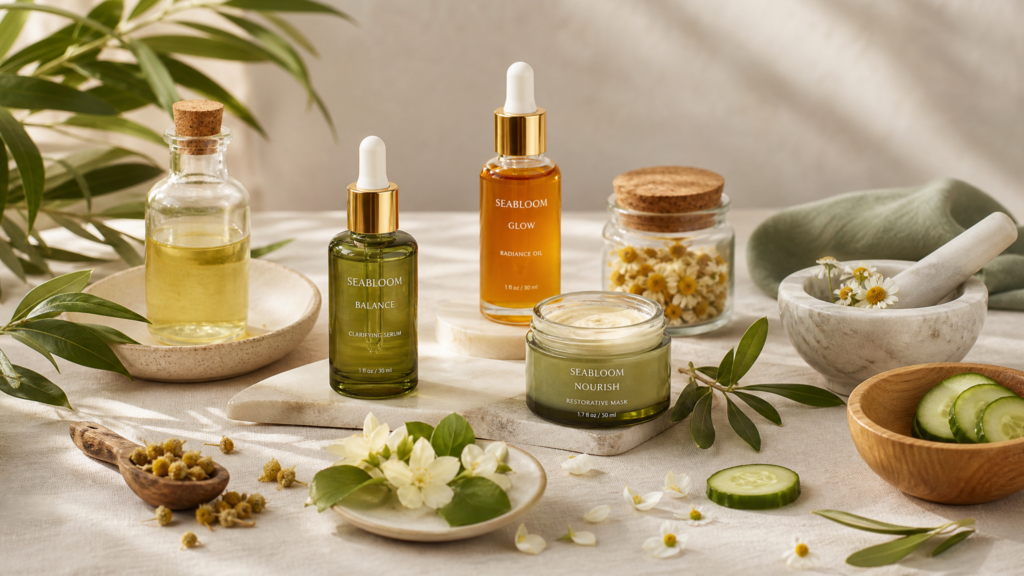

Topical creatine is creatine formulated into a cream or serum for application to your skin. Small human studies of creatine-containing formulas report improvements in firmness and wrinkle appearance. The important qualification: those formulas also contained other ingredients, so the results do not establish what creatine alone would do for your face.
The ingredient familiar from gym supplements has a legitimate skincare research history. What it needs is careful interpretation, especially when a laboratory finding becomes a headline about lifting skin.
Why creatine appears in skin research
Creatine participates in the phosphocreatine system, which helps cells maintain their supply of ATP, a molecule used to power cellular work. Skin cells use energy too, including fibroblasts involved in maintaining the dermal matrix. That gives researchers a biological reason to investigate creatine in skin. It does not, by itself, prove a visible firming effect.
The September 2026 Journal of Clinical and Aesthetic Dermatology review brings this work together, but its literature search closed in March 2025. It is a new review of earlier research, not a newly completed clinical trial. Read the review and its limitations.
What did the human studies actually test?
A creatine, guarana and glycerol face-care formula
Peirano and colleagues investigated a formula containing creatine, guarana and glycerol in a 2011 paper. The work combined laboratory experiments with an assessment of facial aging in male volunteers. The authors reported antiwrinkle and antisagging effects, alongside laboratory evidence relevant to collagen production. The researchers were affiliated with Beiersdorf, a skincare manufacturer. See the original study record.
According to the 2026 review, 43 men applied a formula containing 0.2% creatine twice daily for six weeks. Imaging found an average jowl-volume change of −0.21 mL at four weeks and −0.27 mL at six weeks versus baseline; 39 participants contributed to the six-week measurement. These are changes in an imaging measurement, not a percentage facelift or a guaranteed visible result for you. Study details as summarized in the review.
The practical distinction is between evidence for a tested formula and evidence for every product containing an ingredient. Finding “Creatine” on a different serum’s label does not establish that it delivers the same exposure or outcome.

A folic acid and creatine formula
A separate 2011 study by Fischer and colleagues tested a commercially available formulation containing folic acid and creatine. The researchers assessed firmness with an instrument that measures skin’s mechanical response and used imaging to examine collagen structure. They also conducted complementary laboratory experiments.
The study reported improved firmness after topical use and laboratory changes consistent with effects on collagen metabolism. Again, the tested intervention contained both ingredients. The authors’ affiliation was Beiersdorf Research & Development. These findings support further investigation of the combination; they do not establish an independent effect size for creatine alone. Read the Fischer study abstract.
A collagen result in a dish is not a lifting result on your face
A cultured fibroblast experiment can help answer whether an ingredient changes a cellular process under particular conditions. A human trial asks a different question: what happens when people use a complete product on living skin?
Keep those endpoints separate when reading a claim. Increased procollagen in a laboratory does not mean your facial collagen will rise by the same percentage. An instrument detecting a change in skin geometry also does not tell you how obvious that change will look in everyday lighting.

How to assess a creatine skincare claim
- Ask what was tested. A finished-product trial is more directly relevant to that product than a study of a raw ingredient.
- Check the comparison. Improvement from baseline and improvement over an otherwise identical control formula are different findings.
- Read the ingredient combination. Creatine plus other actives should be described as a combination.
- Look for the actual endpoint. Firmness, wrinkle appearance, hydration and collagen production are not interchangeable measurements.
- Check who ran the work. Manufacturer-affiliated research can be informative, while independent replication adds confidence.
Our editorial view: treat creatine as an interesting formulation ingredient with preliminary human evidence, rather than a reason to rebuild a routine that already suits your skin. This article does not identify a verified creatine product in our current brand selection, so it includes no substitute product recommendation.
Topical creatine: quick answers
Does creatine cream tighten skin?
Some tested creatine-containing formulas improved measured firmness or signs of aging. That evidence does not establish that every creatine cream tightens skin, or predict the size of your result.
Is 0.2% the best concentration?
It is a concentration reported for one studied formula, not an established optimum. A concentration appearing in a paper is not a dose recommendation for every formulation.
Does taking creatine improve skin firmness?
The 2026 review found no direct studies establishing an oral-creatine benefit for skin firmness. Topical and oral use should not be treated as interchangeable evidence. Review findings.
Can I recreate the trial by mixing supplement powder into moisturizer?
No. Adding powder does not recreate the tested formulation or its delivery conditions. The studies above do not validate a homemade mixture.
Research checked September 5, 2026. Images are conceptual illustrations, not clinical results. This article explains cosmetic research and does not provide a treatment plan.