
If your skin flushes, stings, or breaks out every time you try something new, you already know the struggle is real. Sensitive skin isn’t a flaw — it’s a skin type that needs a smarter, gentler approach. And in 2026, organic skin care has never been better equipped to deliver exactly that.
The clean beauty space has matured enormously. We now have peer-reviewed research backing many plant-based ingredients, stricter certification standards, and formulations sophisticated enough to rival conventional dermatology brands. This guide cuts through the noise so you can build a routine that actually works — without the guesswork or the redness.
What Is Sensitive Skin, Really?
Sensitive skin is defined by a compromised skin barrier, leading to reactions like stinging and redness. A 2023 review found that up to 70% of individuals report some level of skin sensitivity.
Sensitive skin is characterized by a compromised or overreactive skin barrier — the outermost layer of your skin (the stratum corneum) isn’t doing its job of keeping irritants out and moisture in. When that barrier is weakened, everyday ingredients that most people tolerate easily can trigger stinging, redness, or breakouts on your skin.
A 2023 review in the Journal of the European Academy of Dermatology and Venereology found that up to 70% of people self-report some degree of skin sensitivity, making it one of the most common skin concerns worldwide. That said, “sensitive skin” can look very different from person to person.
Common Signs Your Skin Is Sensitive
- Redness, flushing, or blotchiness after product use or temperature changes
- Stinging, burning, or itching — especially after cleansing
- Tightness or dryness that feels uncomfortable within minutes of washing
- Frequent reactions to new products, even ones marketed as “gentle”
- Visible capillaries or a tendency toward rosacea-like symptoms
- Skin that takes longer than usual to calm down after a reaction
It’s also worth knowing that sensitive skin often overlaps with other conditions like rosacea, eczema (atopic dermatitis), or contact dermatitis. If your reactions are severe or persistent, a board-certified dermatologist can help you identify whether an underlying condition needs targeted treatment alongside your skincare routine.
what causes skin sensitivity and how to strengthen your skin barrier
Why Organic Skin Care Works for Sensitive Skin
Organic skin care is effective for sensitive skin as it minimizes exposure to synthetic irritants. USDA Organic certification requires at least 95% of ingredients to be organically grown, ensuring safer formulations.
Organic skin care reduces your exposure to synthetic irritants — the category of ingredients most likely to trigger reactions in sensitive skin. Conventional products often contain synthetic fragrances, preservative cocktails, and petroleum-derived emollients that can disrupt the skin barrier over time.
Certified organic formulations are required to meet strict ingredient sourcing standards. In the US, USDA Organic certification means at least 95% of ingredients are organically grown and processed without synthetic pesticides or fertilizers. The EU’s COSMOS-Organic standard adds further restrictions on processing methods and synthetic additives.
What “Organic” Actually Means on a Label
Not every product with “organic” on the label is fully certified. Here’s a quick breakdown of what the most common certifications actually guarantee:
| Certification | What It Guarantees | Where It’s Recognized |
|---|---|---|
| USDA Organic | ≥95% organically grown ingredients | USA |
| COSMOS-Organic | Organic sourcing + clean processing standards | EU, UK, global |
| Ecocert | Natural + organic ingredient minimums | EU, global |
| “Made with organic” | ≥70% organic — remaining ingredients may be synthetic | USA |
The bottom line: look for a recognized certification seal, not just the word “organic” in the product name. For sensitive skin especially, knowing exactly what’s in your products — and what isn’t — matters more than marketing language.
Best Organic Ingredients for Sensitive Skin
Effective organic ingredients for sensitive skin include colloidal oat, known for its soothing properties due to avenanthramides, which calm inflammation and hydrate without irritation.
The most effective organic ingredients for sensitive skin work by calming inflammation, reinforcing the skin barrier, and delivering hydration without irritation. Here are the ones with the strongest evidence behind them.
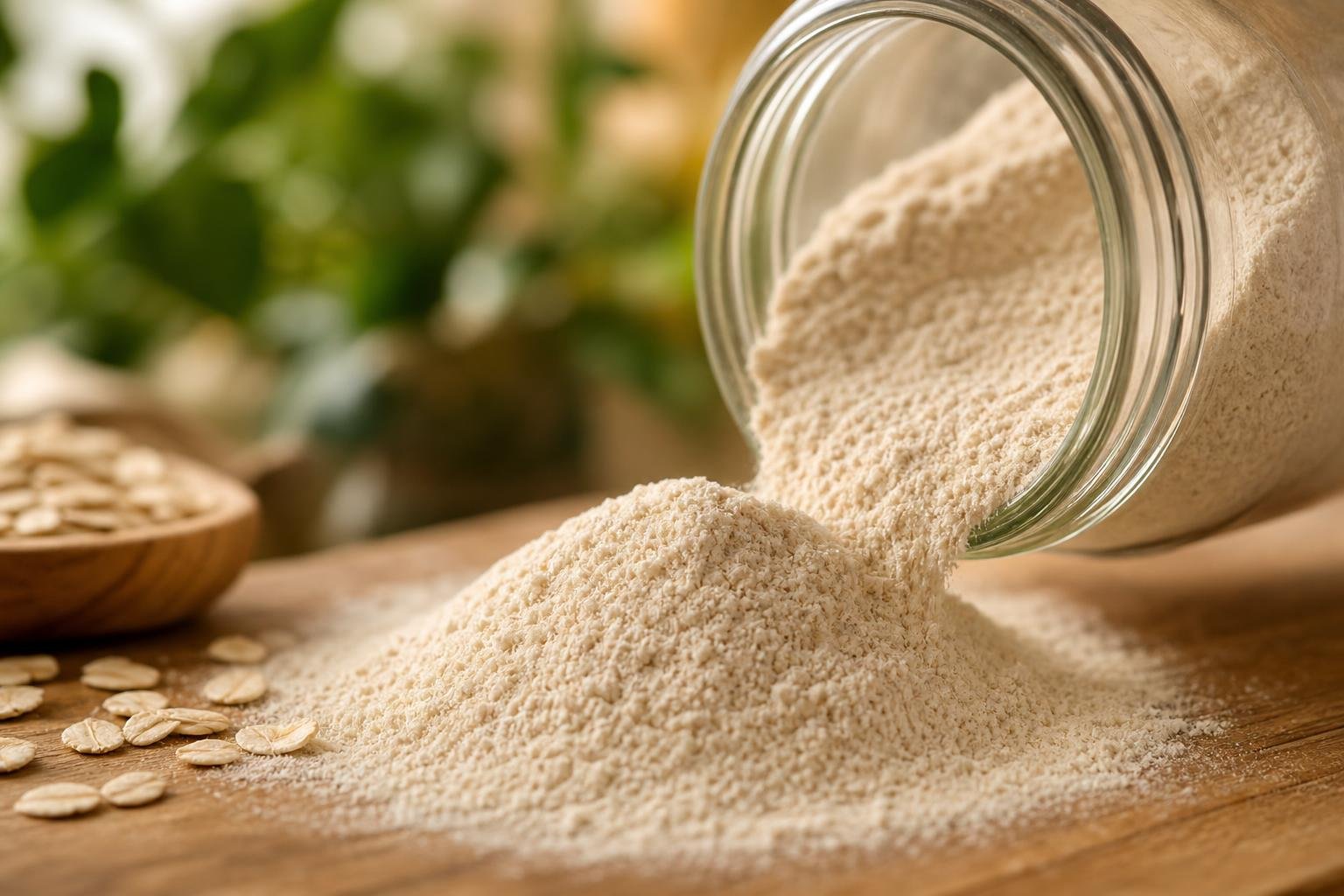
Colloidal Oat (Avena Sativa)
Colloidal oat is one of the most well-researched soothing ingredients in dermatology. It contains avenanthramides — polyphenols with antioxidant and skin-calming properties — as well as beta-glucan, which supports the skin barrier and helps skin hold onto moisture.
Colloidal oatmeal at 1% concentration visibly reduces itch and redness associated with dry, sensitive skin, according to Kurtz & Wallo 2007, Journal of Drugs in Dermatology. It’s also recognized as a skin protectant by the FDA, making it one of the few natural ingredients with official regulatory backing.
Chamomile (Matricaria Chamomilla)
Chamomile extract is a go-to for visibly calming reactive skin. Its active compound, bisabolol, helps reduce the appearance of redness and supports a more even-looking complexion. It’s gentle enough for daily use and works well in both cleansers and moisturizers.
If you’re looking for a moisturizer built around this ingredient, the Eminence Organics Calm Skin Chamomile Moisturizer is formulated specifically to soothe redness and hydrate sensitive skin, with antioxidant protection and no parabens, gluten, or nuts.
Centella Asiatica (Cica)
Centella asiatica — often called “cica” — has become one of the most popular barrier-repair ingredients in clean beauty, and for good reason. Its key compounds (asiaticoside, madecassoside, and asiatic acid) help support the skin’s natural recovery process and visibly reduce the look of irritation.
Madecassoside at 0.1% visibly reduces skin sensitivity scores and supports barrier function in subjects with reactive skin, according to Bylka et al. 2014, Advances in Dermatology and Allergology. Look for it listed as Centella asiatica extract or Centella asiatica leaf water on the INCI.
Aloe Vera (Aloe Barbadensis Leaf Juice)
Aloe vera is a classic for a reason. It delivers lightweight hydration, helps visibly calm post-sun or post-irritation redness, and has a well-established safety profile for sensitive skin. Choose products that list aloe as one of the first ingredients — not buried near the bottom of the INCI list.
Rosehip Seed Oil (Rosa Canina)
Cold-pressed rosehip seed oil is rich in linoleic acid, an omega-6 fatty acid that helps support the skin barrier and improve the look of uneven tone. It’s a lighter alternative to heavier plant oils, making it suitable even for sensitive skin that leans oily.
Organic rosehip seed oil delivers trans-retinoic acid equivalents that may help improve the appearance of skin texture without the irritation associated with synthetic retinol, according to Valerón-Almazán et al. 2015, Clinical and Cosmetic Investigational Dermatology.
Niacinamide (Vitamin B3)
Niacinamide is a water-soluble vitamin that helps visibly minimize pores, reduce the appearance of redness, and support the skin barrier — all without the irritation risk of stronger actives like retinol or AHAs. It’s well-tolerated by most sensitive skin types at concentrations of 2–5%.
Niacinamide at 5% concentration visibly reduces the appearance of hyperpigmentation by up to 35% over 8 weeks, according to Bissett et al. 2005, Journal of Cosmetic Dermatology. For sensitive skin, starting at 2% and building up is a sensible approach.
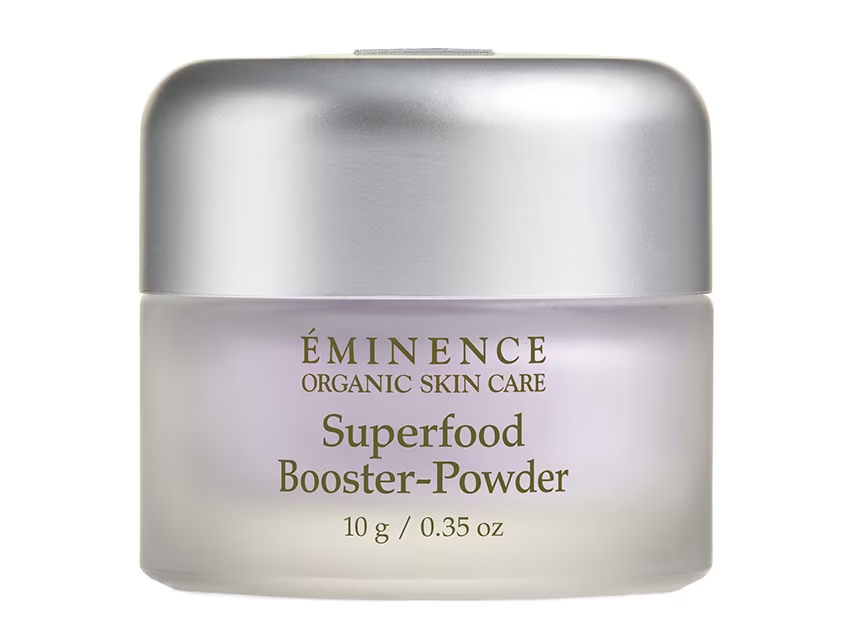
Eminence Organics Skin Care Superfood Booster-Powder – 0.35 oz by OpenWPAgent
$60.00
Ingredients to Avoid — Even in “Natural” Products
Common irritants in skincare can be natural; synthetic fragrances are the leading cause of contact dermatitis. It’s crucial to avoid these irritants, even in ‘natural’ products.
Here’s the part that surprises most people: some of the most common irritants in skincare come from natural sources. “Natural” and “gentle” are not the same thing. Knowing what to avoid is just as important as knowing what to look for.
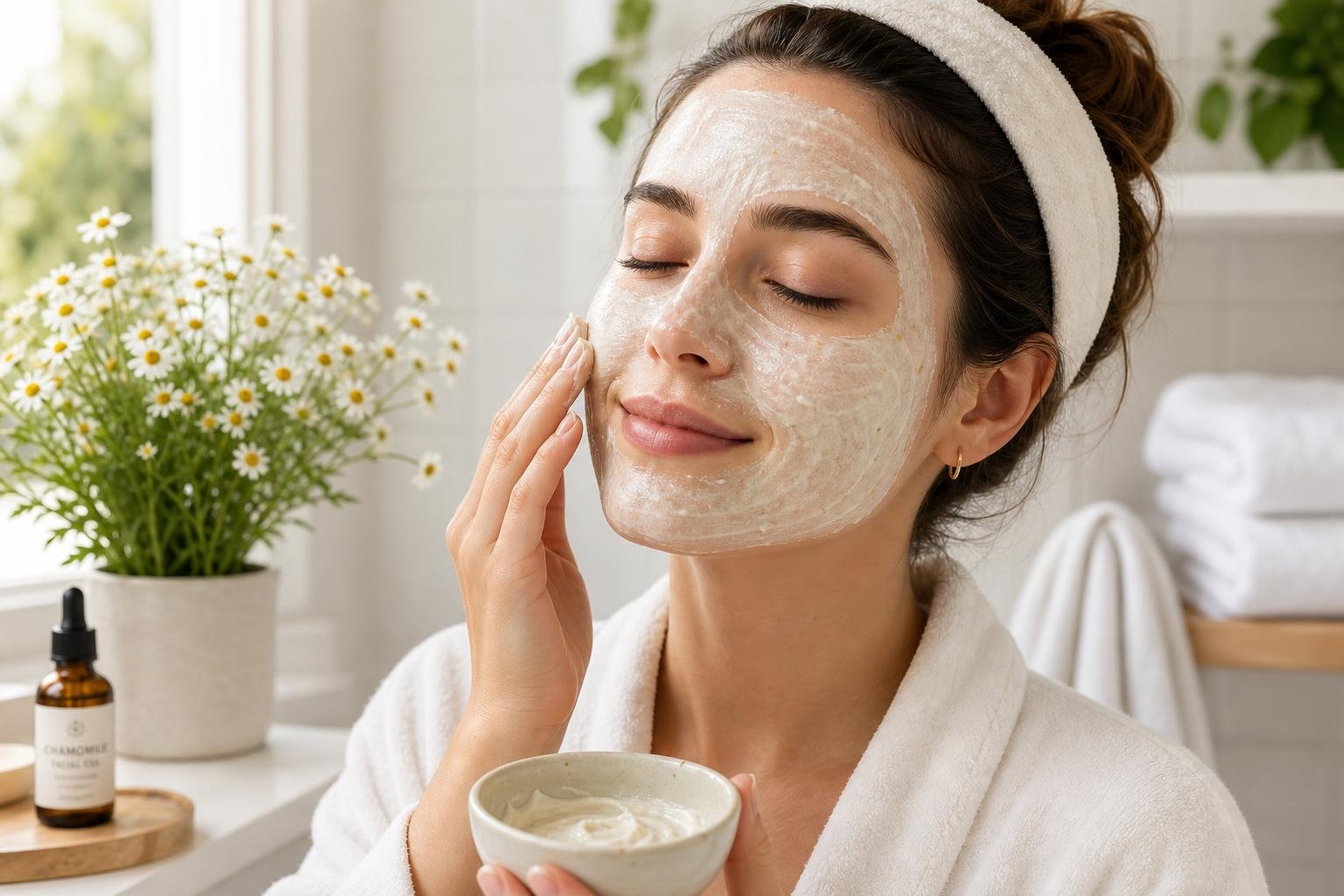
Ingredients That Commonly Trigger Sensitive Skin
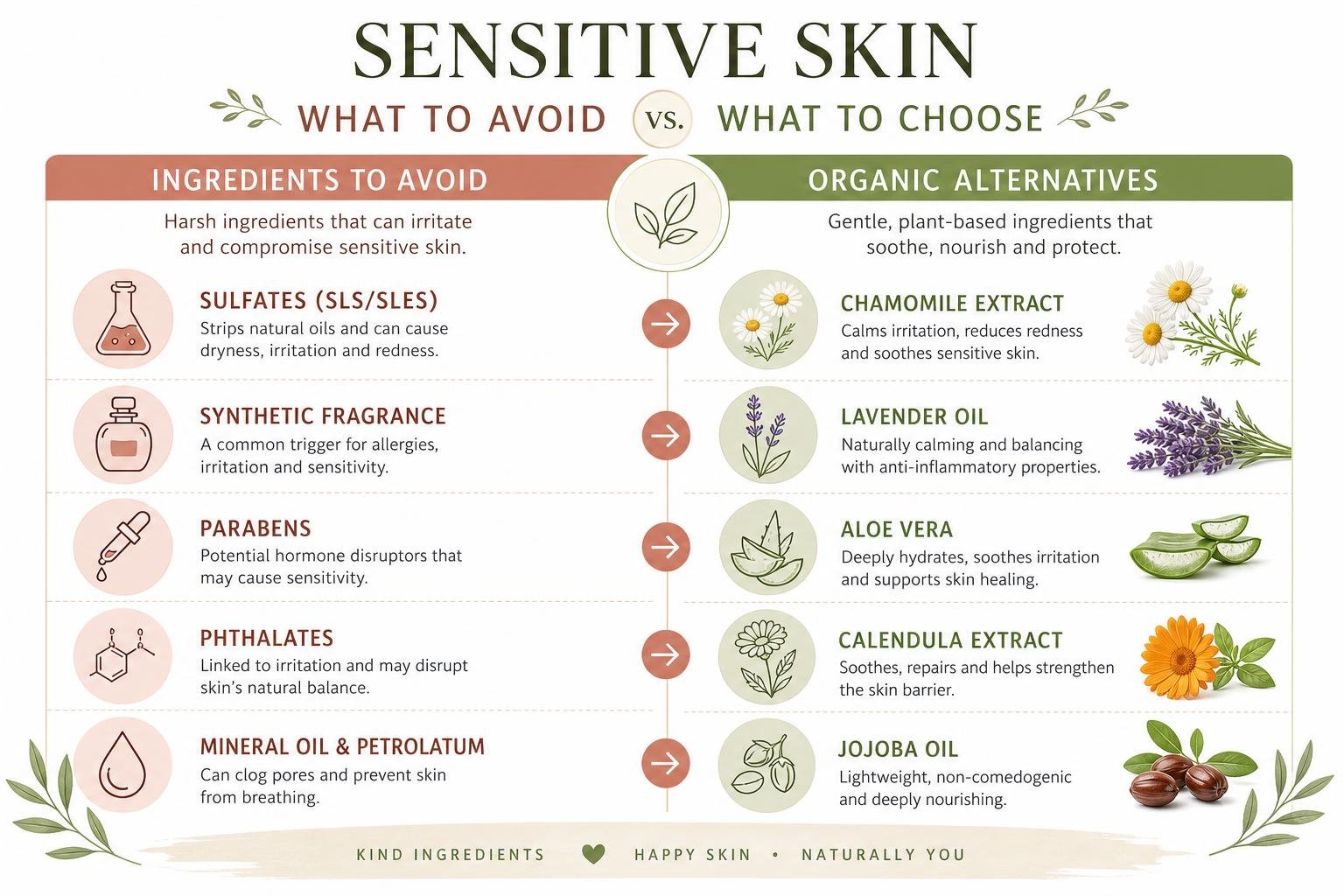
- Synthetic fragrance (Parfum / Fragrance) — The single most common cause of contact dermatitis in skincare. A single “fragrance” listing can represent dozens of undisclosed chemicals. Avoid entirely for sensitive skin.
- Essential oils in high concentrations — Lavender, peppermint, eucalyptus, and citrus oils are natural but can be potent irritants, especially around the eyes and on reactive skin. Small amounts in rinse-off products are generally lower risk; leave-on products are higher risk.
- Alcohol denat. (denatured alcohol) — A drying, barrier-disrupting ingredient used as a solvent and preservative. Not the same as fatty alcohols (cetyl alcohol, stearyl alcohol), which are actually skin-conditioning.
- Sodium lauryl sulfate (SLS) — A surfactant that strips the skin barrier. Even in “natural” cleansers, SLS can cause tightness and irritation. Look for gentler alternatives like sodium cocoyl isethionate or decyl glucoside.
- High-concentration AHAs and BHAs — Glycolic acid above 5% and salicylic acid above 1% can be too aggressive for reactive skin. If you want to exfoliate, start low and slow.
- Witch hazel (with alcohol) — Often marketed as a natural toner, but alcohol-based witch hazel extracts can be drying and irritating. Alcohol-free witch hazel is a gentler option.
- Certain preservatives — Methylisothiazolinone (MI) and methylchloroisothiazolinone (MCI) are among the most common contact allergens in rinse-off products. Look for products preserved with phenoxyethanol, sodium benzoate, or natural alternatives like rosemary extract.
how to patch test skincare products the right way
Building Your Organic Sensitive Skin Routine
For sensitive skin, a streamlined routine of 3–4 steps is recommended. Start with a gentle, low-pH cleanser and consider a calming serum, avoiding hot water to protect the skin barrier.
The golden rule for sensitive skin: less is more. A streamlined 3–4 step routine with well-chosen products will outperform a 10-step routine packed with actives every single time. Here’s how to build it.
Morning Routine
- Step 1 — Gentle Cleanser: Use a low-pH, fragrance-free cleanser with mild surfactants. Rinse with lukewarm water — hot water strips the barrier. If your skin isn’t visibly dirty in the morning, a simple water rinse is enough.
- Step 2 — Calming Serum or Essence (optional): A centella asiatica or niacinamide serum applied to damp skin helps lock in hydration and visibly reduce redness before moisturizer.
- Step 3 — Moisturizer: Choose a fragrance-free formula with barrier-supporting ingredients like ceramides, oat extract, or chamomile. Apply while skin is still slightly damp to seal in moisture.
- Step 4 — Mineral SPF 30+: This is non-negotiable. UV exposure worsens sensitivity and accelerates visible aging. Zinc oxide-based mineral sunscreens are generally better tolerated by sensitive skin than chemical UV filters.
Evening Routine
- Step 1 — Double Cleanse (if wearing SPF or makeup): Start with a gentle micellar water or cleansing oil to remove SPF, then follow with your low-pH cleanser. Skip the double cleanse on nights when you haven’t worn SPF or makeup.
- Step 2 — Treatment (2–3 nights per week, if needed): A low-percentage niacinamide serum or a gentle plant-based facial oil like rosehip. Avoid layering multiple actives — sensitive skin needs recovery time.
- Step 3 — Moisturizer: Use the same moisturizer as your morning routine, or switch to a slightly richer formula at night if your skin tends toward dryness.
If you want to add a targeted booster to your routine without overhauling it, the Eminence Organics Skin Care Superfood Booster-Powder is a smart option — it blends into your existing moisturizer and delivers botanical vitamin C, K, and B3 to help visibly brighten and even out your complexion without adding another full product step.
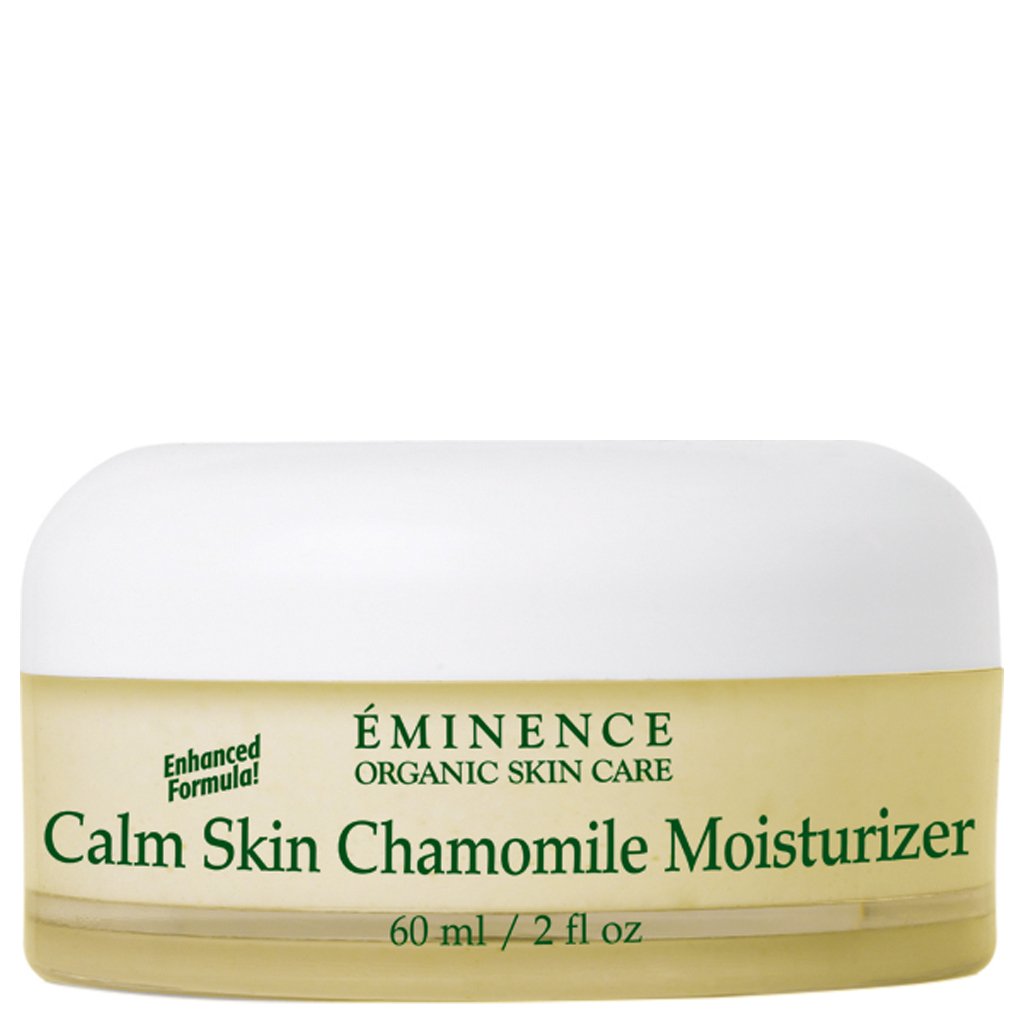
Eminence Organics Calm Skin Chamomile Moisturizer – 2 fl. oz by OpenWPAgent
$62.00
How to Choose the Right Organic Products for Sensitive Skin
To choose the right organic products for sensitive skin, look for fragrance-free labels, a short ingredient list, and recognizable components to minimize potential triggers.
Choosing the right products comes down to reading labels carefully and knowing your own skin’s triggers. Here’s a practical framework to use every time you evaluate a new product.
Your 5-Point Product Checklist
- ✅ Fragrance-free: “Unscented” is not the same as fragrance-free — unscented products can still contain masking fragrances. Look for “fragrance-free” explicitly on the label.
- ✅ Short, recognizable INCI list: Fewer ingredients generally means fewer potential triggers. If you can’t identify most of the ingredients, that’s a flag worth investigating.
- ✅ Certified organic seal: USDA Organic, COSMOS-Organic, or Ecocert certification gives you third-party verification of ingredient sourcing.
- ✅ pH-appropriate for skin: Your skin’s natural pH is around 4.5–5.5. Cleansers and toners that are too alkaline (pH 7+) can disrupt the barrier. Many organic brands now list pH on their packaging or website.
- ✅ Tested for sensitive skin: Look for “dermatologist-tested” or “tested on sensitive skin” claims — these indicate at least some level of clinical evaluation, though they don’t replace your own patch test.
Decoding the INCI List
INCI (International Nomenclature of Cosmetic Ingredients) is the standardized system for listing skincare ingredients. Ingredients are listed in descending order of concentration — so the first five ingredients make up the bulk of the formula. If water (Aqua) is first and your soothing ingredient is near the bottom, it’s present in a very small amount.
For sensitive skin, you want your calming actives — oat extract, centella asiatica, chamomile — appearing in the top half of the list. If they’re listed after the preservatives, they’re likely present at less than 1% concentration.
how to read a skincare ingredient label
![Phyris Anti-Aging [ For Sensitive Skin ] - 50ml](https://organicskincare.com/wp-content/uploads/2022/05/Phyris-Anti-Aging-For-Sensitive-Skin.jpg)
Common Mistakes to Avoid With Sensitive Skin
Common mistakes for sensitive skin include over-cleansing and neglecting SPF. Daily broad-spectrum SPF 30 use can prevent about 24% of visible aging signs, with mineral zinc oxide being better tolerated.
Even with the best intentions, certain habits can keep your skin in a cycle of reactivity. Here are the most common mistakes — and how to fix them.
Mistake 1: Over-Cleansing
Washing your face more than twice a day — or using a cleanser that’s too stripping — is one of the fastest ways to compromise your barrier. Cleanse once in the evening and rinse with water in the morning unless you’ve been sweating heavily.
Mistake 2: Introducing Too Many New Products at Once
If you add three new products in the same week and your skin reacts, you won’t know which one caused it. Introduce one new product at a time, wait two weeks, then add the next. It feels slow, but it’s the only way to know what your skin actually likes.
Mistake 3: Skipping SPF Because It Irritates Your Skin
Many people with sensitive skin have had bad experiences with chemical sunscreens — stinging, redness, or breakouts. The solution isn’t to skip SPF — it’s to switch to a mineral formula with zinc oxide as the only active ingredient. These are far less likely to cause reactions.
Mistake 4: Assuming “Natural” Means Safe for Your Skin
As we covered above, natural ingredients can absolutely cause reactions. Poison ivy is natural. So is lemon juice. Always evaluate ingredients on their individual safety profile, not just their origin.
Mistake 5: Using Hot Water
Hot water feels soothing in the moment but strips your skin’s natural lipids and leaves your barrier more vulnerable. Lukewarm water is the sweet spot — warm enough to cleanse effectively, cool enough to protect your barrier.
Frequently Asked Questions
Organic skin care is often better for sensitive skin as it avoids synthetic irritants. However, not all organic products are gentle; always check the ingredient list and certification seals.
Is organic skin care better for sensitive skin than conventional skin care?
Organic skin care can be better for sensitive skin because it typically avoids synthetic fragrances, harsh preservatives, and petroleum-derived ingredients — which are among the most common triggers for reactive skin. That said, “organic” alone isn’t a guarantee of gentleness. Always check the full ingredient list and look for a recognized certification seal like USDA Organic or COSMOS-Organic.
Can sensitive skin use retinol?
Yes, but with caution. Synthetic retinol can cause significant irritation on sensitive skin, especially at higher concentrations. A gentler alternative is organic rosehip seed oil, which contains naturally occurring trans-retinoic acid equivalents that may help improve the appearance of skin texture with a lower risk of irritation, according to Valerón-Almazán et al. 2015, Clinical and Cosmetic Investigational Dermatology. If you want to use retinol, start at 0.025% and apply it only 1–2 nights per week.
What is the best organic moisturizer for sensitive skin?
Look for a fragrance-free, certified organic moisturizer with barrier-supporting ingredients like colloidal oat, chamomile, centella asiatica, or ceramide-rich plant oils. The Eminence Organics Calm Skin Chamomile Moisturizer is a well-regarded option formulated specifically to soothe redness and hydrate sensitive skin, free of parabens, gluten, and synthetic fragrance.
How long does it take for organic skin care to work on sensitive skin?
Most people notice a visible reduction in redness and reactivity within 4–6 weeks of consistently using a simplified, barrier-focused routine. Skin cell turnover takes approximately 28 days, so give any new routine at least one full cycle before evaluating results. Avoid switching products during this period — consistency is key for sensitive skin.
Are essential oils safe for sensitive skin?
Not always. Essential oils are natural but can be potent irritants, especially lavender, peppermint, eucalyptus, and citrus oils. For sensitive skin, it’s safest to choose fragrance-free products or those where essential oils appear very low on the INCI list (indicating a small concentration). Always patch test before applying any essential oil-containing product to your face.
Can I use niacinamide if I have sensitive skin?
Yes — niacinamide is one of the best-tolerated actives for sensitive skin. At 2–5% concentration, it helps visibly reduce redness, minimize the appearance of pores, and support the skin barrier. Start at 2% if your skin is highly reactive, and avoid combining it with high-concentration vitamin C (L-ascorbic acid) in the same step, as this can cause temporary flushing in some people.
The Bottom Line
[{“@context”:”https://schema.org”,”@type”:”Article”,”headline”:”Organic Skin Care for Sensitive Skin”,”author”:{“@type”:”Organization”,”name”:”OrganicSkinCare”,”url”:”https://organicskincare.com”},”publisher”:{“@type”:”Organization”,”name”:”OrganicSkinCare”,”url”:”https://organicskincare.com”},”datePublished”:”2026-04-21T08:23:41″,”dateModified”:”2026-07-21T08:04:06.877Z”,”image”:”https://organicskincare.com/wp-content/uploads/2026/07/organic-skin-care-for-sensitive-skin-ful-feature-image.jpg”},{“@context”:”https://schema.org”,”@type”:”Product”,”name”:”Eminence Organics Skin Care Superfood Booster-Powder – 0.35 oz”,”brand”:{“@type”:”Brand”,”name”:”OpenWPAgent”},”offers”:{“@type”:”Offer”,”price”:60,”priceCurrency”:”USD”,”url”:”https://organicskincare.com/product/eminence-organics-skin-care-superfood-booster-powder/”,”availability”:”https://schema.org/InStock”},”image”:”https://organicskincare.com/wp-content/uploads/2023/10/Eminence-Organics-Skin-Care-Superfood-Booster-Powder.jpg”},{“@context”:”https://schema.org”,”@type”:”Product”,”name”:”Eminence Organics Calm Skin Chamomile Moisturizer – 2 fl. oz”,”brand”:{“@type”:”Brand”,”name”:”OpenWPAgent”},”offers”:{“@type”:”Offer”,”price”:62,”priceCurrency”:”USD”,”url”:”https://organicskincare.com/product/eminence-organics-calm-skin-chamomile-moisturizer/”,”availability”:”https://schema.org/InStock”},”image”:”https://organicskincare.com/wp-content/uploads/2023/03/Eminence-Organics-Calm-Skin-Chamomile-Moisturizer.jpeg”},{“@context”:”https://schema.org”,”@type”:”Product”,”name”:”Phyris Anti-Aging [ For Sensitive Skin ] – 50ml”,”brand”:{“@type”:”Brand”,”name”:”OpenWPAgent”},”offers”:{“@type”:”Offer”,”price”:56,”priceCurrency”:”USD”,”url”:”https://organicskincare.com/product/phyris-anti-aging-for-sensitive-skin/”,”availability”:”https://schema.org/InStock”},”image”:”https://organicskincare.com/wp-content/uploads/2022/05/Phyris-Anti-Aging-For-Sensitive-Skin.jpg”},{“@context”:”https://schema.org”,”@type”:”Product”,”name”:”Eminence Organic Calm Skin Chamomile Cleanser – 8.4 fl. oz.”,”brand”:{“@type”:”Brand”,”name”:”OpenWPAgent”},”offers”:{“@type”:”Offer”,”price”:42,”priceCurrency”:”USD”,”url”:”https://organicskincare.com/product/eminence-vitaskin-calm-skin-chamomile-cleanser/”,”availability”:”https://schema.org/InStock”},”image”:”https://organicskincare.com/wp-content/uploads/2012/06/Eminence-Organic-Calm-Skin-Chamomile-Cleanser-1.jpg”},{“@context”:”https://schema.org”,”@type”:”Product”,”name”:”Eminence Organics Clear Skin Probiotic Cleanser – 8.4 fl. oz”,”brand”:{“@type”:”Brand”,”name”:”OpenWPAgent”},”offers”:{“@type”:”Offer”,”price”:48,”priceCurrency”:”USD”,”url”:”https://organicskincare.com/product/eminence-organics-clear-skin-probiotic-cleanser/”,”availability”:”https://schema.org/InStock”},”image”:”https://organicskincare.com/wp-content/uploads/2023/03/Eminence-Organics-Clear-Skin-Probiotic-Cleanser.jpg”}]
Written with AI assistance.


