
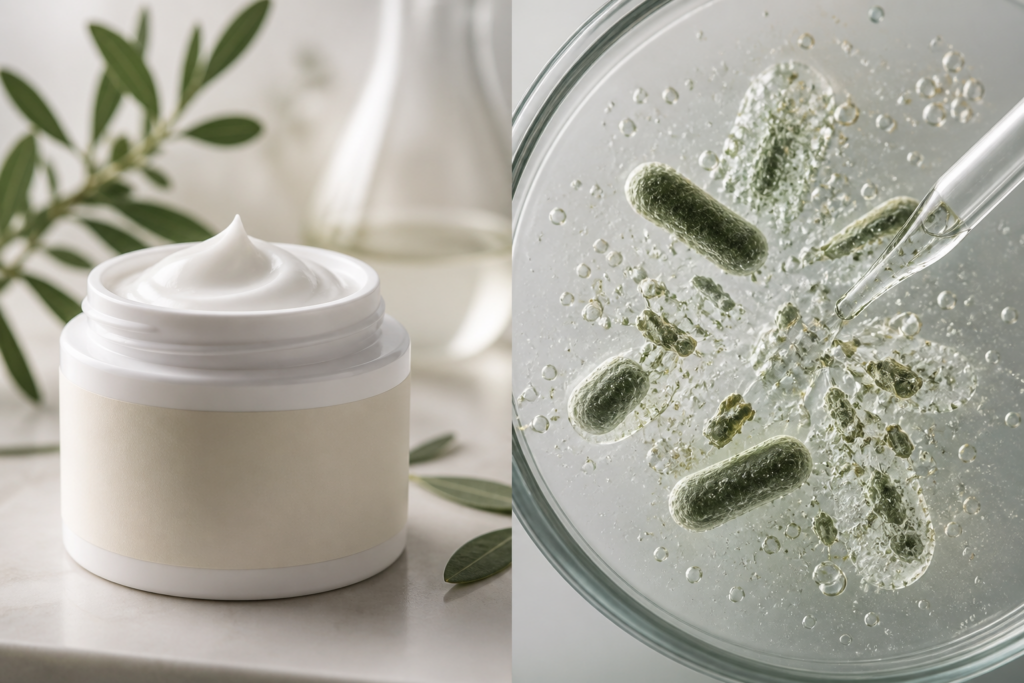
If you are comparing probiotic vs postbiotic skincare, ignore the product name and read the INCI. A probiotic is a live microorganism, used at an adequate dose, with a demonstrated benefit. A postbiotic is a preparation of inanimate microorganisms and/or their components that also has a demonstrated health benefit in the target host (Salminen et al., ISAPP 2021). Most leave-on creams sold as a probiotic moisturizer contain Lactococcus Ferment Lysate: lysed cells, not a living culture.
That lysate is a postbiotic-type ingredient. It is not automatically a proven postbiotic. The rest of this post is an INCI decoder, not a trend list.
What is a postbiotic in skincare
ISAPP’s 2021 consensus is the bar worth using, even though it was written for the gut and a skin-specific ISAPP definition has not been formally established (Chia et al., Cosmetics 2026, 13(1)43).
- Probiotic: live microorganisms, adequate dose, demonstrated benefit.
- Postbiotic: inanimate microorganisms and/or their components, with a demonstrated health benefit in the target host.
What is a postbiotic in skincare, in practice, is a narrower claim than the marketing copy. Ferments, lysates, filtrates, cell-wall fragments, and leftover metabolites are the usual ingredients. Calling one of those a postbiotic is only accurate if a benefit was actually shown. Most cosmetic lysates are postbiotic-type materials. They are not proven postbiotics by the ISAPP definition.
A probiotic, by contrast, has to be alive. Jane Yoo, MD (updated 18 June 2026) treats topical probiotic skincare as live bacterial strains applied to the skin surface. That is the scientific use of the word. It is not how most cosmetic names are written.
If older copy on this site treated probiotic skincare as live bacteria in a jar, that was the industry shorthand, not an accurate INCI reading. Relabeling a lysate as a probiotic does not change the chemistry. This post is the INCI reading.
Live vs lysate: a preserved leave-on cannot carry live cultures
Live cells and a conventional preservative system are opposing design goals. A water-containing cream has to stay free of unintended growth on the shelf. Alcohol, salicylates, benzoates, and sorbates make the water phase hostile to microbes, including any Lactococcus a marketer might wish were still viable.
Chia et al. put the formulation problem in one sentence: organisms “may be incorporated as live bacteria, although they are more frequently included as ferments or lysates due to formulation challenges.” Live strains are sensitive to pH in manufacture, temperature in transit, and moisture once the pack is opened. Typical preserved leave-on cosmetics do not deliver durable colonization. That is not the same as saying a live strain can never persist under any laboratory condition. It is what a standard cream, in a standard jar, actually does.
ISO 17516 sets colony-count limits for cosmetics as a contamination spec. It is not a license to sell live probiotics. A cream that passes ISO 17516 is “acceptably clean.” It is not a live-culture product.
If the INCI already lists alcohol, salicylic acid or sodium salicylate, sodium benzoate, or potassium sorbate, you do not need a CFU test to finish the argument. That formula is not a live-culture vehicle.
How to read the INCI: Lactococcus Ferment Lysate is not a live probiotic
Lactococcus Ferment Lysate is the INCI name you will see most often in this category. Decode it in three words:
- Lactococcus: the genus that was grown (usually L. lactis).
- Ferment: the organism was cultured. Fermentation happened. It does not mean the finished cream is still fermenting.
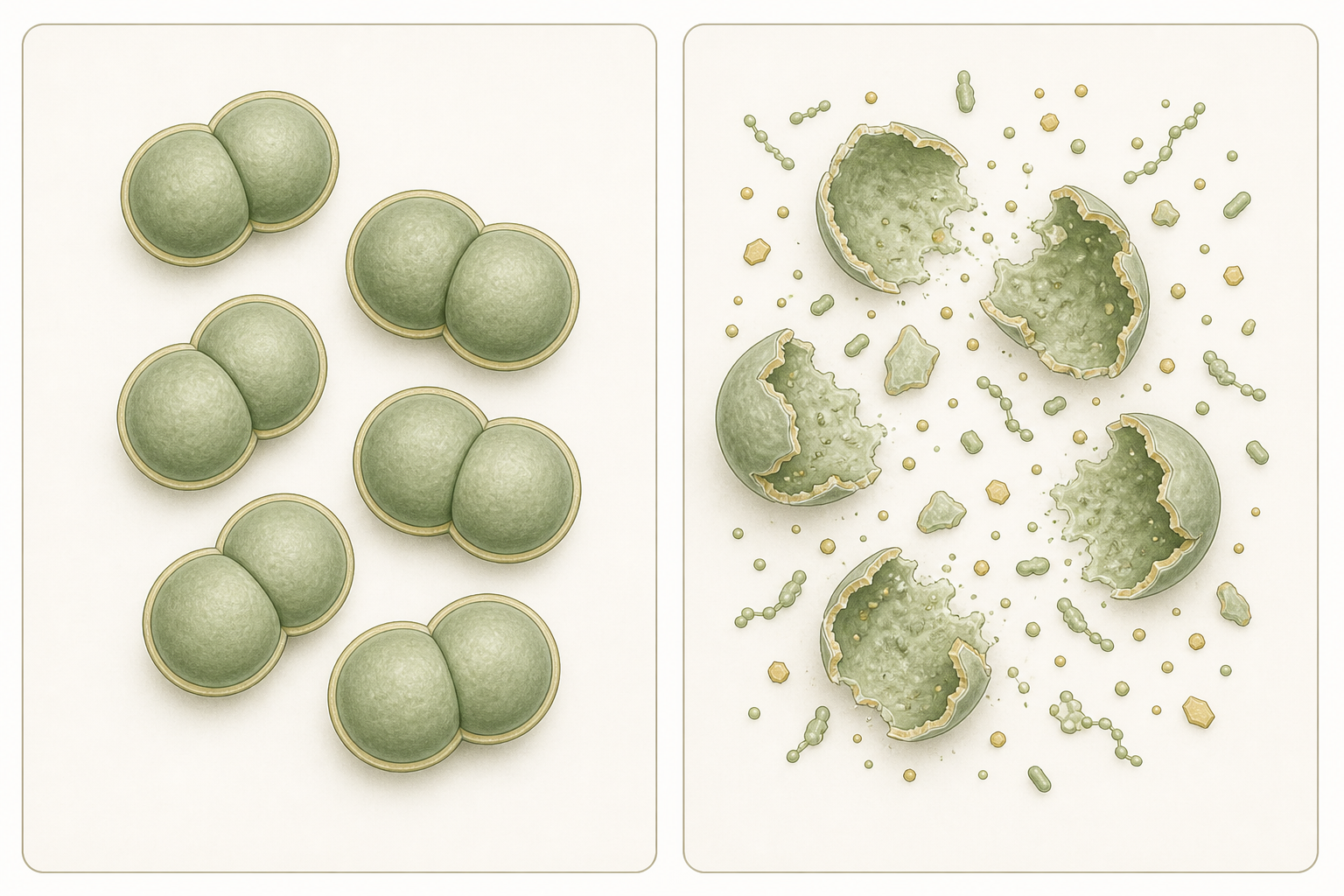
- Lysate: the cells were broken. You are looking at inanimate material (cytoplasm, wall fragments, metabolites), not intact viable cells.
That is a postbiotic-type ingredient. It is not a probiotic. It is also not automatically a postbiotic under ISAPP, because “lysate” does not, by itself, prove a health benefit in the target host.
Related INCI stems follow the same logic. Ferment Lysate, Ferment Filtrate, and Ferment Extract are processed, non-viable fractions. None of those words means live. If a brand wanted to declare a live culture, you would expect a strain name, a viability statement, and a preservation system compatible with that claim. You will almost never see that on a leave-on cream.
Chia et al. are blunt about the labeling gap: “Many cosmetic products marketed as probiotic-containing formulations include non-viable bacterial derivatives, such as ferments or lysates, which are more accurately categorised as postbiotics as these are dead microorganisms.” Their Table 3 classifies Biossance Squalane + Probiotic Gel Moisturiser as marketed probiotic, ISAPP class postbiotic. Same naming problem, published in a 2026 review. The same paper notes that live cells are the minority format because of preservatives.
A 2021 survey of 50 cosmetics labeled probiotic found none listed a strain. Of the microbial ingredients that were listed, 8% named a species, and 78% were ferments, extracts, filtrates, or lysates (Puebla-Barragan and Reid, Molecules 2021). That is the labeling pattern. It is not a 2026 market share, and it is not a live-count.
If you came to a probiotic moisturizer as a gentler barrier option than a ceramide cream, the INCI still decides what you bought. The name does not.

Worked example 1: the name says probiotic, the INCI is a lysate
ilike Probiotic Moisturizer with Elderflower and Blackberry ($105.50, listed $128.50, SKU ipmeb2) is the clean teaching case. The product name is Probiotic Moisturizer. That name is the front-of-pack claim. On OrganicSkinCare.com the marketing list writes “Lactococcus Ferment Lysate (probiotic).” The manufacturer, Szepelet, uses the same parenthetical on its active-ingredient line.
The full INCI is not on the OSC product page. It is on the manufacturer page. After Lactococcus Ferment Lysate you get, among other things, Benzyl Alcohol, Alcohol, Sodium Salicylate, Salicylic Acid, Sodium Benzoate, and Potassium Sorbate.
That is a preserved leave-on with a lysate. It cannot carry live cultures. Calling the lysate a probiotic is a naming habit, including on a product we sell. It is still the wrong term.
The same “Probiotic” product name appears on ilike Probiotic Serum with Elderflower and Blackberry ($105.50, listed $128.50) and ilike Probiotic Day & Night Treatment with Elderflower and Blackberry ($97.50). Read those INCIs the same way: look for Ferment Lysate, then look for the preservative system. Full INCI for the serum and Day & Night is also on Szepelet, not on OSC.
Worked example 2: the manufacturer says lysate, the FAQ still says probiotic
Dr. Grandel SensiCode Rejuvenating Cream ($64) is the contrast case. The product name does not say probiotic. The INCI on OSC lists Lactococcus Ferment Lysate and matches the manufacturer listing on grandel.de.
Grandel’s own copy is the more accurate of the two. It calls the active Skin Biotic Balancer, “a lysate of lactic acid bacteria (Lactococcus lactis).” That is a postbiotic-type description. OSC’s FAQ still writes “probiotic Lactococcus Ferment Lysate.” The INCI did not change. The adjective did.
The same lysate shows up in Dr. Grandel SensiCode Moisturizing Cream ($64) and Dr. Grandel SensiCode Eye Cream ($42). Different textures, same INCI tell.
This cream does not list alcohol, salicylates, benzoate, or sorbate. It does not need to. Lysate already tells you the cells were broken. Preservation style is supporting evidence, not the definition.
What these products can and cannot claim
A lysate can still do useful work. Yoo’s 2026 reading is that postbiotics currently have the better mix of evidence and formula practicality, and that fermented lysates have shown barrier-supportive and anti-inflammatory properties in studies. Allowed language for these two SKUs is modest: they can support barrier function, help with hydration, and calm reactivity through signaling from lysates and metabolites.
They cannot claim to rebalance your microbiome. They cannot claim live probiotics in the jar. They cannot claim to treat acne, rosacea, or eczema. There is no honest CFU number for a lysate. Colonization is not the mechanism of either cream. They also cannot be sold as proven ISAPP postbiotics unless a demonstrated host benefit is attached to that specific preparation.
Chia et al. also flag the evidence ceiling: limited robust in vivo data, regulatory ambiguity, and inconsistent definitions and marketing claims. A separate 2026 Applied Microbiology review covers probiotic and postbiotic dermocosmetics. It does not give this shop a license to oversell two moisturizers.
Manufacturer softness or wrinkle percentages, where a brand reports them, are brand reports. They are not proof that a live culture survived the preservative system.
FAQ
What is a postbiotic in skincare?
A postbiotic is an inanimate preparation of microorganisms and/or their components that confers a demonstrated health benefit on the host (ISAPP 2021). There is not yet a separate, formal ISAPP definition written only for skin. A ferment or lysate in a cream is a postbiotic-type ingredient. It is a postbiotic only if that benefit was shown.
Is Lactococcus Ferment Lysate a probiotic?
No. Lactococcus Ferment Lysate is a lysate of Lactococcus cells. That is a non-viable, postbiotic-type INCI. A probiotic would be live, dosed, and tied to a demonstrated benefit. If the product name says probiotic and the INCI says lysate, believe the INCI.
How do I read a probiotic moisturizer INCI?
Search the list for Ferment Lysate, Ferment Filtrate, or Ferment Extract. Then search for Alcohol, salicylates, sodium benzoate, and potassium sorbate. Lysate tells you the cells are dead. Those preservatives tell you the base was never built to keep them alive.
Is a probiotic moisturizer the same as postbiotic skincare?
Often, in the jar, yes, even though the names disagree. If the INCI lists Lactococcus Ferment Lysate (or another ferment lysate or filtrate), you bought a postbiotic-type cream sold under a probiotic name. A true probiotic moisturizer would need live cells, a viability claim, and a preservation system that does not kill them. That is not what the ilike or SensiCode SKUs above are.
Can a preserved leave-on cream contain live probiotics?
Not in any useful sense, if the INCI includes a standard anti-microbial system. Live cells and benzoate/sorbate/alcohol/salicylate preservation fight each other. Formulators who want a true live product have to design around viability, not drop a lysate into a conventional cream and rename it. ISO 17516 contamination limits do not convert a preserved cream into a probiotic.
Do postbiotic moisturizers colonize the skin?
Typical preserved leave-on cosmetics do not deliver durable colonization. Yoo’s point is that applied live strains do not readily colonize either; any effect is more likely transient surface signaling. For a lysate, colonization is not even a coherent mechanism. The cells are already inanimate.
Sources
- Salminen S, et al. ISAPP consensus statement on the definition and scope of postbiotics. Nat Rev Gastroenterol Hepatol. 2021. https://www.nature.com/articles/s41575-021-00440-6
- ISAPP resource page for the same consensus: https://isappscience.org/resource/expert-consensus-document-the-international-scientific-association-for-probiotics-and-prebiotics-isapp-consensus-statement-on-the-definition-and-scope-of-postbiotics/
- Chia J, et al. The Skin Microbiome Revolution: The Science and Challenges of Prebiotics, Probiotics, and Postbiotics in Skincare. Cosmetics 2026, 13(1), 43. Published 13 Feb 2026. DOI 10.3390/cosmetics13010043. https://www.mdpi.com/2079-9284/13/1/43
- Jane Yoo MD. Microbiome Skincare in 2026: What the Science Actually Supports. Updated 18 June 2026. https://www.janeyoomd.com/microbiome-skincare-in-2026-what-the-science-actually-supports/
- Puebla-Barragan S, Reid G. Probiotics in Cosmetic and Personal Care Products: Trends and Challenges. Molecules 2021, 26(5), 1249. PMC7956298. https://www.ncbi.nlm.nih.gov/pmc/articles/PMC7956298/
- Almeida et al. Probiotic and Postbiotic Approaches in Modern Dermocosmetics. Appl. Microbiol. 2026, 6(6), 69. Published 9 June 2026. DOI 10.3390/applmicrobiol6060069. https://www.mdpi.com/2673-8007/6/6/69 (cited as a 2026 dermocosmetic review only; full PDF was not used)
- ilike Probiotic Moisturizer, OSC product page: https://organicskincare.com/product/ilike-probiotic-moisturizer-with-elderflower-and-blackberry/
- ilike Probiotic Moisturizer, manufacturer INCI: https://www.szepelet.com/products/probiotic-moisturizer-with-elderflower-and-blackberry/
- ilike Probiotic Serum: https://organicskincare.com/product/ilike-probiotic-serum-with-elderflower-and-blackberry/
- ilike Probiotic Day & Night Treatment: https://organicskincare.com/product/ilike-probiotic-day-night-treatment-with-elderflower-and-blackberry/
- Dr. Grandel SensiCode Rejuvenating Cream, OSC product page: https://organicskincare.com/product/dr-grandel-rejuvenating-cream/
- Dr. Grandel Rejuvenating Cream, manufacturer (Skin Biotic Balancer / Lactococcus lactis lysate): https://www.grandel.de/dr-grandel-kosmetik/experts/rejuvenating-cream
- Dr. Grandel SensiCode Moisturizing Cream: https://organicskincare.com/product/dr-grandel-sensicode-moisturizing-cream/
- Dr. Grandel SensiCode Eye Cream: https://organicskincare.com/product/dr-grandel-sensicode-eye-cream/
- Older OSC copy this post supersedes: https://organicskincare.com/7-benefits-of-probiotic-skin-care/


