Search Results for: organic face oil

Best Organic Face Washes for Oily Skin 2026: Expert Guide - organic skincare guide

Best Organic Face Washes for Oily Skin 2026: Expert Guide

My quest for the best organic face wash for oily skin has taught me that the journey to a balanced and clear complexion begins with the right skincare choices. For those of us navigating the challenges of an oily skin type, the struggle to find an organic face wash for oily skin that cleanses without over-drying is real. I understand the importance of selecting a cleanser that not only addresses the excess sebum but also maintains necessary hydration, aiming to preserve that precious moisture barrier. Having tried and tested numerous products, I’ve discovered that a natural face wash for oily skin with the right blend of clarifying and hydrating ingredients can leave our skin feeling refreshed without the tightness or discomfort of being stripped dry.

In search of the best face wash for oily skin, it has become clear to me that organic and natural compositions provide a gentler, yet effective approach to daily cleansing. Let’s dive into the essence of these skin saviors, dedicated to tackling oiliness with respectful care for our skin’s natural rhythm.

Key Takeaways

  • Identifying an organic face wash that effectively balances oil cleansing with moisture retention is key for oily skin.
  • Choosing products with naturally-derived ingredients can prevent the over-stripping of the skin.
  • Regular use of a suitable cleanser is fundamental in achieving a refreshed and non-greasy complexion.
  • An ideal natural face wash for oily skin should leave the skin feeling clean yet supple after every wash.
  • Organic ingredients have the additional benefit of being environmentally friendly and free from harsh chemicals.
  • Products that include traits such as gentle foaming and pH-balancing are worth considering in your skincare routine.
  • Gentle exfoliants present in organic cleansers can help refine pores and improve skin clarity over time.

Understanding Oily Skin and Its Cleansing Needs

As someone who has navigated the complexities of oily skin, I’ve come to understand that sebum, while vital for maintaining our skin’s suppleness, can be a double-edged sword. Excess sebum production from the plethora of sebaceous glands in oily skin types leads to the familiar shiny and often unwelcome greasy appearance. It’s a delicate balance to manage, but managing we must.

To my fellow oily-skinned individuals, have you considered the impact of your environment on your skin’s temperament? High temperatures and rampant humidity levels can indeed make your skin appear greasier. Not to mention, they intensify that uncomfortable sensation of oiliness. But here’s a nugget of truth: the choice of a face wash for oily skin can either make or break your oil-control routine.

Finding the perfect oily skin face wash is pivotal. Consider it the cornerstone of your beauty regime—an integral ritual that sets the stage for the skincare that follows. And yes, the technique holds its weight in gold too. I’ve found that supplementing my face wash routine with the gentle exfoliation of a washcloth can tremendously enhance the cleansing process. Together, this dynamic duo works harmoniously to bestow upon us the fresh, matte canvas we so desire.

  • The right face wash lifts away excess oil without overstripping.
  • Look for cleansers that maintain hydration for enduring comfort post-wash.
  • Employ a washcloth for gentle, daily exfoliation in partnership with your face wash.

The fantastic thing about a commendable face wash for oily skin is that you not only remove the unwanted shine but also prepare your skin to better absorb the goodness from the rest of your skincare. This alignment between cleansing and subsequent product efficacy is what I aspire to bring into focus for you. Let’s continue this journey towards a relentless yet tender war against oiliness.

The Importance of Organic Ingredients in Face Wash for Oily Skin

Embarking on the quest for a refined complexion, I’ve learned to champion organic formulas. The formulation of your face wash can shape your skin’s health, especially when graced with the challenge of oil control. That’s where the allure of organic face wash comes into play—its composition is a tender invitation to embrace nature’s own. Before diving further into the advantages of such products, it’s essential to understand why they’re worth seeking out. Let’s explore.

Why Choose Organic?

A delicate balance is crucial when it comes to managing oily skin. My adoption of an organic face wash was driven by the aspiration to connect with products that are as considerate to my skin as they are to the environment. Organic options forsake the harshness of synthetic additives, aligning skincare with eco-consciousness. This is more than just a trend; it’s a mindful adaptation of lifestyle in harmony with responsible stewardship of our planet’s resources.

Benefits of Natural Ingredients for Oily Skin

Navigating a sea of skincare, one realizes that natural ingredients are akin to a soothing balm for oily-prone skin. As I transitioned to natural face wash selections, the benefits unveiled themselves beyond the surface. Nutrient-rich botanicals have shown a remarkable propensity to purify without provocation, to console skin rather than confront it. My skin, once beleaguered by oil, now revels in a complexion that’s not just clarified, but calmed and curative in its daily renewal.

The Role of Ingredients Like Ceramides and Glycerin in Organic Cleansers

When I embarked on my journey to uncover the best organic face wash, I delved into the science of what makes a cleanser effective, particularly for those of us with oily complexions. At the heart of this investigation was a surprising revelation: ingredients like ceramides and glycerin aren’t just additives; they’re essential pillars in the architecture of superior skincare formulations.

I discovered that ceramides, naturally occurring lipids in our skin, form a fundamental part of the skin’s barrier. This barrier shields against environmental aggressors that can exacerbate oily skin issues. In an organic face wash, ceramides act like sentinels, maintaining barrier function and preventing undue irritation caused by pollutants and various stressors. As a result, they are superior for keeping the skin’s surface calm and resilient.

Simultaneously, glycerin emerged as a standout ingredient. Known as a humectant, glycerin has the innate ability to draw and retain moisture within the skin. This hydration-attracting property ensures that the skin remains supple and hydrated, even after the rigors of cleansing away excess oil. It balances the equation, cutting through the grease while safeguarding the skin’s innate hydration levels – a true hero for those of us grappling with oily yet dehydrated skin.

With these insights, I’m inclined to emphasize the importance of understanding the functional role of each ingredient in your skincare. For those on the hunt for the best organic face wash, I advise looking for cleansers that herald these ingredients as part of their core composition. Below, let’s examine a comparison that showcases the impact of these powerhouses in maintaining skin’s hydration post-cleanse:

Cleanser Type Ceramides Glycerin Skin Hydration Post-Cleanse
Common Face Wash Absent Low Possible Tightness and Dryness
Organic Face Wash with Ceramides & Glycerin Present High Refreshed and Balanced Hydration

As a proponent of organic skincare, I can attest to the difference made by cleansers enriched with these key ingredients. Embracing a formula where ceramides and glycerin work in tandem has been a game-changer in my skincare ritual. The quest for the best organic face wash is not merely about snubbing unwanted shine but also about inviting a complexion that radiates health from the inside out.

Combating Oily Skin: Best Ingredients to Look for in Organic Face Washes

When I’m on the hunt for the best face wash to combat my oily skin, I delve deep into ingredient lists. I’ve discovered that certain components can make a world of difference in managing sebum production without depriving my skin of its natural moisture. Let’s take a close look at these organic multitaskers that deserve a spot in our cleansing routine.

One standout ingredient I always keep my eyes peeled for is niacinamide. Renowned for its oil-regulating properties, niacinamide is a form of vitamin B3 that works wonders for keeping shine at bay. It’s like having a secret weapon that not only tackles oiliness but also supports skin barrier function.

A key player in this skincare game is zinc, noted for its shine-reducing prowess. It soothes inflammation, a common sidekick to our oily skin travails. I’ve found that zinc-infused cleansers are a boon, granting me that sought-after matte but not flat complexion.

Then, there’s the natural source of salicylic acid I look for, derived from plants like willow bark. This beta-hydroxy acid expertly purges my pores, leaving my skin feeling deeply cleansed and clear.

Can’t forget about alpha-hydroxy acids, particularly glycolic acid. These gently exfoliate the uppermost layer of the skin, providing clarity and brightness without stripping away much-needed moisture. It’s a delicate dance of deep cleaning without over-drying, and glycolic acid leads with grace.

  • Niacinamide for oil regulation
  • Zinc for shine reduction and anti-inflammatory action
  • Natural salicylic acid for deep pore cleansing
  • Glycolic acid for exfoliation and maintaining skin clarity

Equipped with this knowledge, finding the best face wash for oily skin becomes a more intentional choice—ditch the guesswork, and stick to nature’s bounty that’s as kind to your skin as it is to the environment.

Expert-Approved: Dermatologist-Recommended Organic Face Washes

In my pursuit to unveil the best organic face wash for oily skin, I’ve immersed myself in the wisdom of skincare experts. Trusted dermatologists extol the virtues of specific organic cleansers that stand out due to their gentle yet efficacious nature. Embracing the collective insights of these skin health custodians, I’ve gravitated towards products that harmonize oil control with inherent skin sensitivity.

What Dermatologists Say About Organic Cleansers for Oily Skin

It’s become increasingly clear that dermatologists advocate for organic cleansers specially formulated for oily skin. The emphasis is on gentle foaming action—capable of meticulously removing excess sebum and day-long accumulations without the harsh aftermath. Their unified message underscores the importance of skin barrier integrity, prompting me to select cleansers that champion this delicate balance.

Dermatologist Favorites: Organic Face Washes That Excel

The accolades by dermatologists center around a few shining examples in the world of organic face cleansers. Their shared characteristic? The inclusion of zinc—a mineral esteemed for its oil-absorbing and soothing demeanor. Zinc not only curtails the gleam of an oily visage but also allies with inflamed skin to restore peace to the complexion. It’s this confluence of cleansing and care that propels such products to the forefront of dermatologist-recommended organic face wash lists.

Product Key Ingredient Action on Oily Skin Texture Dermatologist’s Note
La Roche-Posay Toleriane Purifying Foaming Face Wash Niacinamide, Ceramide-3 Balances oil without barrier disruption Gel to foam Favorited for daily use, even on oily sensitive skin
CeraVe Foaming Facial Cleanser Ceramides, Hyaluronic Acid, Niacinamide Cleanses excess oil, maintains hydration Foaming gel Highlighted for affordability and effectiveness
La Roche-Posay Effaclar Purifying Foaming Gel Cleanser Zinc PCA Regulates oil-production, reduces shine Foaming gel Praised for its purifying zinc content
Cetaphil DermaControl Oil Removing Foam Wash Zinc, Glycerin Instant oil-absorbing foam action Foam Recommended for its gentle, non-drying foam

Guided by these expert opinions, my selection of a face wash moves towards those organic formulations which are specifically aligned with a dermatologist’s vision for treating oily skin. The unanimous preference for cleansers bereft of harsh chemicals, yet potent against oiliness, is a testament to the mindful evolution of skincare. Hence, I confide in these dermatologist favorites, assured that the bar for the best organic face wash for oily skin is set high with thoughtful consideration for our unique skin needs.

Innovative Formulas: Best Organic Gel Cleansers for Oily Skin in 2023

As we settle into 2023, my journey to find the best organic gel cleansers for oily skin has introduced me to formulas that are nothing short of revolutionary. In my experience, gel cleansers are the heroes of the skincare world for those with oily skin. Embracing lightweight textures, these innovative products offer a range of skin benefits that go beyond just cleansing.

One of my top discoveries this year hinges on the transformational impact of white willow bark extract, a natural source of salicylic acid. This botanical powerhouse contributes to the exfoliation process, unclogging pores, and promoting a smoother texture without invoking the dry, tight sensation that other cleansers might induce.

The prowess of these cleansers lies in their multifaceted approach to skin care: they facilitate gentle exfoliation, regulate oil production, and promote cell turnover with a deft touch. Essentials for any product claiming to be among the best organic gel cleansers for oily skin include a balanced pH that ensures compatibility with our skin’s natural state. Moreover, the presence of humectants like glycerin secures hydration where it belongs—in your skin.

Below, I unveil my curated list of superior organic gel cleansers, each standing up to the challenge of oily skin with grace and efficacy:

Cleanser Key Organic Ingredients Primary Benefits Texture
iS Clinical Cleansing Complex White Willow Bark Extract, Antioxidants Exfoliates; Boosts cell turnover Gel
La Roche-Posay Effaclar Purifying Foaming Gel Cleanser Zinc PCA, Thermal Spring Water Controls shine; Reduces oil Foaming Gel
Cetaphil DermaControl Oil Removing Foam Wash Zinc, Glycerin Instant oil-absorption; Non-drying Foam
La Roche-Posay Toleriane Purifying Foaming Face Wash Niacinamide, Ceramide-3, Prebiotic Thermal Water Preserves the moisture barrier; Gentle cleansing Gel to Foam

These standout cleansers are just a glimpse into the expanding world of organic skincare specifically targeted to those of us seeking a matte yet healthily moisturized visage. It’s my genuine belief that integrating one of these top-performing gel cleansers into your daily routine might just be the turning point towards mastering the art of oil control. After all, the best organic gel cleansers for oily skin are those that address our specific needs while contributing to the long-term health and radiance of our complexions.

The Breakthrough of K-Beauty: Organic Options for Oily Skin Care

My journey into the world of K-Beauty has uncovered a treasure trove of organic options catering specifically to oily skin concerns. Harnessing innovative formulations and potent natural ingredients, K-Beauty stands at the forefront of organic skincare solutions. Today, I share with you the remarkable benefits of K-Beauty organic options for oily skin, which are paving the way for a new standard in skincare.

The cutting edge of K-Beauty brings to the table ingredients such as blueberry extract, renowned for its high antioxidant content. These organic components are more than just skin-deep; they provide a multitude of benefits that align perfectly with the needs of oily skin. Let me guide you through the impact of these ingredients on combating common oily skin woes.

  • Antioxidant-rich blueberry extract supports the fight against environmental stressors by neutralizing harmful free radicals.
  • Inflammation, often exacerbated by oily skin, is significantly reduced, thanks to the natural soothing properties of K-Beauty’s botanical extracts.
  • The strategic formulation of K-Beauty cleansers addresses excess sebum without compromising skin hydration, ideal for maintaining balanced skin health.

I’m particularly impressed by how K-Beauty principles have embraced the essence of nature within their organic offerings. These environmentally-conscious choices attest to a deeper understanding of skincare, where health and beauty are not mutually exclusive. The influence of K-Beauty organic options for oily skin is shaping an exciting era in our skincare regimens, one that promises efficacy paired with nature’s gentle touch.

Discovering the secrets held within K-Beauty’s organic selections has been nothing short of revelatory for my oily skin journey. It’s a testament to K-Beauty’s innovation and commitment to holistic care that we now have at our fingertips organic options designed for optimal skin health. The assurance of ingredient purity meshed with the prowess of K-Beauty’s cutting-edge research culminates in products that I confidently trust to bring out the best in my skin.

Oily skin no longer has to be a challenge with limitations in treatment. The fusion of science and nature achieved by K-Beauty perfectly aligns with our needs, providing a beacon of hope for those of us striving towards a balanced, radiant complexion. Join me in embracing the breakthrough that K-Beauty organic options represent in the ongoing pursuit of skin wellness.

Reviews and Ratings: Top-Rated Organic Face Washes for Oily Skin

My trawl through countless organic face wash reviews has opened my eyes to the profound effect of these cleansers on those battling oily complexions. A consistent theme I’ve encountered is the transformative nature of organically formulated face washes, evidenced by the glowing testimonies of satisfied users. as if held together by a cohesive string, the narratives share tales of hydration, clarity, and the vanquishing of that stubborn oily shine. It seems these organic warriors are reshaping skincare regimes, one face wash at a time.

Customer Insights: Real Results from Using Organic Face Washes

Scanning through organic face wash ratings, I’ve noticed a clear picture painted by those who have taken the plunge into the world of organic skincare. They highlight the marked improvement in skin hydration, a critical factor for oily skin prone to overcompensate with oil due to dryness. The gratifying reduction in pore-clogging and the resulting decrees in shine are just some of the tangible benefits users acclaim. It’s this type of real-world feedback that solidifies the credibility of product efficiency.

Community Favorites: Most Loved Organic Cleansers

As I delve deeper into the heart of organic skincare communities, certain products stand tall as crowd favorites. It’s the spirit of shared discovery that illuminates the power of these beloved cleansers. Their unique blends of natural ingredients not only promise but deliver brighter, more vivacious skin. Below is a table compiled from community feedback showcasing the top-rated organic face washes for those of us in the oily skin brigade.

Organic Face Wash Key Ingredients User Feedback Overall Rating
La Roche-Posay Effaclar Purifying Foaming Gel Zinc PCA, Thermal Spring Water Praised for reducing shine without drying 4.5/5
Cetaphil DermaControl Oil Removing Foam Wash Zinc, Glycerin Lauded for gentle yet effective oil control 4.6/5
La Roche-Posay Toleriane Purifying Foaming Face Wash Niacinamide, Ceramide-3 Adored for preserving moisture barrier 4.7/5
KraveBeauty Matcha Hemp Hydrating Cleanser Matcha, Hemp Seed Oil Commended for awakening and rejuvenating skin 4.8/5

Price Point Analysis: Affordable vs. Premium Organic Face Washes

In evaluating affordable organic face wash for oily skin, I’ve observed that cost-effective choices often incorporate fundamental yet potent ingredients like zinc and glycerin. These elements cater to the key requirements of oily skin—effectively managing sebum and hydration without imposing financial strain on the consumer. On the flip side, those with a penchant for indulgence may be drawn to premium organic face wash options. These high-end concoctions celebrate a plethora of exotic botanical components, featuring sophisticated multi-tasking abilities that justify their heftier price tag.

As I continue my mission to discern the value in both ends of the market spectrum, let’s compare some specific examples of these organic face washes to illuminate their respective benefits and justifications for their cost.

Organic Face Wash Price Category Key Ingredients Benefits Size
CeraVe Foaming Facial Cleanser Affordable Ceramides, Hyaluronic Acid, Niacinamide Cleanses without stripping, maintains hydration 8 oz
iS Clinical Cleansing Complex Premium White Willow Bark Extract, Antioxidants Exfoliates, clears pores, while calming and healing skin 6 oz
La Roche-Posay Effaclar Purifying Foaming Gel Cleanser Affordable Zinc PCA, Thermal Spring Water Purifies and reduces shine 6.76 oz
Ole Henriksen Find Your Balance Oil Control Cleanser Premium Green Fusion Complex, Glycolic and Lactic Acids Clarifies pores and reduces excess oil 5 oz

Through my analysis, it’s clear that affordable organic face wash offerings deliver no-nonsense solutions tailored to the practicalities of daily life. These products are accessible and reliable, making them ideal for cost-conscious individuals who seek efficiency without extravagance.

Conversely, I regard the premium organic face wash alternatives as a form of skincare luxury, inviting those willing to invest more to enjoy pioneering formulas rich in innovation and unique components. The latter often promise sensorial satisfaction and extensive skincare benefits, appearing to transcend the mere act of cleansing.

Whether one leans towards an economical or lavish approach, the organic face wash market caters to all preferences, promising to address the complexities of oily skin with astute product diversity.

Best Organic Face Wash for Oily Skin: Our Top Picks

It’s no secret that finding the best organic face wash for oily skin can feel like searching for a needle in a haystack. Oily skin requires a special kind of care, especially when it comes to cleansing. After considerable research and testing, I’ve curated a list of top picks for organic face wash that not only tackle the challenges of oil but do so with natural finesse.

Best Organic Face Wash for Oily Skin Based on Efficacy and Ingredients

The selected organic face washes earn their stripes through a combination of efficacy and ingredient integrity. My commitment to discovering products that yield tangible results without compromising on quality guided this selection. Here’s an illuminating look at how these cleansers fared.

Brand Active Ingredients Benefits Price
La Roche-Posay Toleriane Purifying Foaming Face Wash Niacinamide, Ceramide-3, Prebiotic Thermal Water Removes excess oil without disrupting moisture barrier $17
CeraVe Foaming Facial Cleanser Ceramides, Hyaluronic Acid, Niacinamide Refreshes and hydrates with foaming gel texture $17
iS Clinical Cleansing Complex White Willow Bark Extract, Centella Asiatica Resurfaces and clears pores while calming the skin $45
Naturium Benzoyl Peroxide Cream Cleanser 5% Benzoyl Peroxide Gentle on the skin, prevents new acne breakouts $18

How Our Selections Stand Out From the Rest

What distinguishes these cleansers is the harmonious blend of nature’s offerings and scientific innovation. Each product on this list brings something unique to the table—from utilizing naturally derived acids for exfoliation to incorporating advanced hydrators like hyaluronic acid for moisture retention. They aren’t just cleansers; they are holistic care for oily skin. Here are a few standout features:

  • La Roche-Posay is championed for gentle yet effective daily use, catering to both oil reduction and sensitivity concerns.
  • CeraVe’s inclusion of niacinamide helps to regulate oil production, making it a staple for many with oily skin.
  • The iS Clinical Cleansing Complex balances exfoliation with healing, showcasing its multipurpose nature.
  • Naturium’s innovative use of micronized benzoyl peroxide proves that strong acne-fighting ingredients can still be kind on oily skin.

These top picks for organic face wash represent a cross-section of the best the market offers for those grappling with oily skin in 2023. Prioritizing both plant-based purity and palpable results, each cleanser promises to uphold the delicate equilibrium necessary to maintain clear, balanced, and healthy skin.

As someone who places great importance on both the health of my skin and the environment, these organic cleansers are more than just products—they are a testament to the power of conscious skincare choices. Through diligent selection and expert formulation, the battle against oily sheen can be won, ensuring that those of us with slicker skin types can enjoy the glow of good health rather than the gleam of excess oil.

Conclusion

In my exploration of the best natural face wash for oily skin, I’ve discovered that the ideal choice lies in a cleanser that offers a delicate balance—capable of regulating oil without depriving the skin of its essential moisture. Organic face washes of 2023, particularly those that have earned my stamp of approval, unite the power of gentle ingredients with stellar outcomes confirmed by user experiences. The diverse lineup, spanning from nurturing foaming formulas to transformative gel cleansers, signals a shared commitment to nurturing skin health through organic and natural elements.

The consensus that emerges is clear: a commendable organic cleanser is the linchpin in establishing and maintaining a polished, yet naturally radiant complexion. In this organic face wash conclusion, my journey validates the enduring wisdom that the organic route offers a pathway to clarity, equilibrium, and the true essence of skin wellness.

Prioritizing organic formulations in my daily skincare ritual has not only addressed my oily skin concerns but has also aligned me closer to nature’s rhythm. This intentional choice exemplifies the relationship between skin efficacy and purity, solidifying my belief in the profound impact of organic skincare. Whether one selects a cost-effective option or indulges in a premium cleanse, the overarching goal remains the same—to bid farewell to the unwelcome sheen and evoke the fresh visage that we, as advocates of oily skin care, so ardently seek.

FAQ

What are the best organic face washes for oily skin in 2023?

The best organic face washes for oily skin are those that effectively remove excess oil, balance sebum production, and contain natural ingredients like niacinamide, zinc, and salicylic acid. Standout options in 2023 include gel cleansers with white willow bark extract and foaming formulations with blueberry extract known for their efficacies in managing oily skin while being gentle.

Why is it important to choose an organic face wash for oily skin?

Organic face washes are important for oily skin because they cleanse without using harsh chemicals that can irritate and aggravate the skin. They also support environmentally responsible formulations and often include nutrient-rich ingredients that benefit oily skin by soothing and healing it.

What role do ceramides and glycerin play in organic cleansers?

Ceramides and glycerin are key ingredients in organic cleansers because they help to maintain the skin’s hydration and barrier integrity, even while cleansing oily skin. Ceramides strengthen the skin’s natural barrier, while glycerin, a humectant, locks in moisture to prevent over-drying after oil is removed.

Which ingredients should I look for in organic face washes to combat oily skin?

To manage oily skin, look for ingredients such as niacinamide for oil regulation, zinc for reducing shine and calming inflammation, natural sources of salicylic acid for deep pore cleansing, and alpha-hydroxy acids like glycolic acid for gentle exfoliation.

What do dermatologists say about organic cleansers for oily skin?

Dermatologists often recommend gentle, foaming organic cleansers for oily skin as they effectively purge excess oil and impurities while minimizing the risk of irritation and over-drying. Key ingredients favored by dermatologists include zinc and niacinamide for their soothing and oil-regulating properties.

Are organic gel cleansers a good choice for oily skin?

Yes, organic gel cleansers are a great choice for oily skin due to their lightweight nature, which provides thorough exfoliation and oil control without leaving skin feeling tight or dry. They often contain innovative ingredients that help refine pores and fight dullness while promoting healthy cell turnover.

How have K-Beauty organic options influenced face washes for oily skin?

K-Beauty has introduced unique organic formulations that cater to oily skin, utilizing ingredients such as blueberry extract for its antioxidant benefits, which aid in neutralizing free radicals and minimizing inflammation, making them effective options for oily skin care.

What do customer reviews say about the efficacy of organic face washes for oily skin?

Customer reviews generally highlight improvements in skin hydration, reduced clogging of pores, and decreased oily sheen when using organic face washes. Users often praise the blend of natural ingredients in these formulations for delivering clearer and brighter skin.

Are there affordable organic face wash options for oily skin?

Yes, there are budget-friendly organic face wash options for oily skin that feature effective cleansing ingredients, such as zinc and glycerin. These cleansers can offer simplicity and efficacy at a more affordable price point.

How do the top organic face washes for oily skin stand out from the rest?

Top organic face washes stand out due to their ability to cleanse thoroughly while respecting the skin’s natural balance, employing a blend of traditional and innovative natural ingredients that are specially formulated for managing oily skin.

Best Organic Face Washes for Oily Skin 2026: Expert Guide Read More »

Refreshed hero image for: Discover the Best Organic Facial Oils for Anti-Aging and Mature Skin

Discover the Best Organic Facial Oils for Anti-Aging and Mature Skin

As we age, our skin changes and requires additional attention to retain its youthful look. One of the best ways to do this is by using top organic facial oils for anti-aging and mature skin. Organic facial oils formulated with potent ingredients can nurture your skin while diminishing wrinkles, fine lines, and other indications of aging. But how can one decide which product to opt for? In this blog post we’ll discuss the benefits of organic facial oils for anti-aging and mature skin, types available on the market today as well as tips on choosing a product suitable for your specific needs. We’ll also look at common ingredients found in these top organic facial oils for anti-aging & mature skin plus side effects associated with their use so you know what to expect when incorporating them into your skincare routine.

Table of Contents:

Benefits of Organic Facial Oils for Anti-Aging and Mature Skin

Organic facial oils can provide a number of benefits for those with mature and aging skin. These botanically-derived oils are loaded with essential lipids, free radical scavengers, vitamins and other advantageous components that can nurture the skin while diminishing the look of wrinkles and fine lines.

Hydration and Nourishment:

Organic facial oils are rich in hydrating properties that help to keep the skin moisturized throughout the day. They also contain essential fatty acids such as omega-3s which help to nourish the skin from within. This helps to reduce dryness and flakiness while providing much needed nutrients for healthier looking skin.

Improved Skin Texture:

The use of organic facial oils can also improve your overall complexion by evening out your tone and texture. By helping to reduce inflammation, these natural products can minimize redness or discoloration caused by sun damage or age spots over time. Additionally, they may even be able to reduce scarring from acne breakouts or other blemishes on your face as well as promote cell turnover for smoother looking skin.

Organic facial oils are a potent anti-aging and mature skin care solution, providing profound hydration, nutrition, refined texture and reduced wrinkles. By using the right type of organic facial oil for your skin type, you can enjoy these benefits while taking steps towards a healthier complexion.

 
Key Takeaway: Organic facial oils can be advantageous for mature and aging skin, enhancing hydration, nourishment, texture, and complexion.

Types of Organic Facial Oils for Anti-Aging and Mature Skin

Types of Organic Facial Oils for Anti-Aging and Mature Skin

  1. Rosehip Oil – Rich in antioxidants and vitamins A and C, it helps to reduce the appearance of fine lines and wrinkles and improve skin texture.

  2. Argan Oil – Packed with fatty acids and vitamin E, it nourishes and moisturizes the skin, improves elasticity, and reduces the appearance of fine lines.

  3. Jojoba Oil – Known for its moisturizing and anti-inflammatory properties, it can help to reduce the appearance of wrinkles and fine lines and improve skin elasticity.

  4. Marula Oil – Rich in antioxidants and fatty acids, it helps to hydrate and moisturize the skin and reduce the appearance of fine lines and wrinkles.

  5. Sea Buckthorn Oil – Contains high levels of antioxidants and vitamins C and E, it can help to improve skin tone and texture and reduce the appearance of fine lines and wrinkles.

  6. Prickly Pear Seed Oil – Contains high levels of vitamin E and essential fatty acids, it helps to hydrate and nourish the skin and improve its elasticity.

  7. Evening Primrose Oil – Contains high levels of gamma-linolenic acid, which can help to reduce inflammation and improve skin texture and elasticity.

  8. Pomegranate Seed Oil – Contains high levels of antioxidants and vitamins C and E, it can help to reduce the appearance of fine lines and wrinkles and improve skin texture.

  9. Tamanu Oil – Known for its healing properties, it can help to reduce the appearance of fine lines and wrinkles and improve skin elasticity.

  10. Carrot Seed Oil – Contains high levels of vitamin A and beta-carotene, it can help to improve skin texture and reduce the appearance of fine lines and wrinkles.

It’s important to note that while facial oils can be very beneficial for mature skin, it’s always a good idea to patch test first and introduce new products gradually to avoid any adverse reactions.

Top Organic Facial Oils for Anti-Aging and Mature Skin

How to Choose the Right Organic Facial Oil for Your Skin Type

When deciding on the best organic facial oil for your skin type, there are some essential points to think about. For those with dry skin types, look for oils that contain essential fatty acids and antioxidants such as jojoba oil or argan oil. These ingredients help nourish and hydrate the skin while protecting against environmental damage. Oily skin types should opt for lighter oils like rosehip oil which helps balance sebum production without clogging pores. Combination skin types can benefit from using a combination of both heavier and lighter oils depending on their individual needs.

For dry skin types, it’s important to select an oil that will provide ample hydration without leaving behind any greasy residue. Jojoba oil is an excellent choice for dry skin types, due to its omega-9 fatty acids which can help retain moisture while shielding the complexion from oxidative damage and external stressors. Argan Oil is another great choice due to its high content of vitamin E which helps reduce inflammation while improving overall texture and tone of the complexion over time.

Oily skins tend to be more prone to breakouts so selecting an appropriate facial oil is essential in keeping blemishes at bay. Rosehip Oil is lightweight yet deeply hydrating making it perfect for oily complexions as it won’t clog pores or cause further irritation when applied topically. This particular ingredient also contains Vitamin A which has been known to improve cell turnover rate resulting in fewer breakouts over time with regular use.

Combination skins require special attention when selecting a facial oil since they may need different levels of hydration depending on where you apply them on your face (i.e., forehead vs cheeks). In this case, opting for two separate products might be beneficial – one light weight option like rosehip seed or almond kernel followed by something richer like avocado or coconut can work wonders if used correctly together. Lastly, always remember that everyone’s individual needs vary so what works well for someone else may not necessarily be ideal for you – do some research beforehand and find out what ingredients are best suited towards your unique skincare routine.

When selecting an organic facial oil for your skin type, consider the components and their advantages as well as the texture of the item carefully. Now that you’re equipped with the knowledge of how to select an organic facial oil for your skin type, let’s explore ways to make use of it in order to combat aging and mature skin.

 
Key Takeaway: The key takeaway is that the right facial oil should be chosen based on your skin type, with dry skin types requiring oils high in fatty acids and antioxidants, oily skin types needing lighter oils like rosehip oil, and combination skins benefitting from a mix of both heavier and lighter oils.


How to Use Organic Facial Oils for Anti-Aging and Mature Skin Effectively?

Using organic facial oils for anti-aging and mature skin can be a great way to keep your skin looking youthful and radiant. Organic facial oils are packed with essential fatty acids, antioxidants, vitamins A, C, E & K that help nourish the skin while reducing the appearance of fine lines and wrinkles. It is critical to pick an appropriate oil for your skin type in order to take full advantage of its advantages.

Cleanse Your Face First:

Before applying any facial oil it is important to make sure you cleanse your face first. This will help remove dirt, makeup or other impurities from your pores so that they can absorb all of the beneficial ingredients found in organic facial oils more effectively. Use a gentle cleanser that won’t strip away natural oils from your face such as one made with aloe vera or coconut oil.

Apply The Right Amount Of Oil:

Applying too much oil on your face can cause breakouts due to clogged pores so it’s important not to overdo it when using organic facial oils for anti-aging purposes. Start by dispensing 2-3 drops onto the palm of your hand then use both hands together like a sandwich around the area you want to apply it on before gently patting into place until fully absorbed into the skin.

Once the necessary quantity of product has been applied, it is beneficial to knead it in a rising motion, beginning at the neck and progressing up towards the brow. This helps stimulate circulation while encouraging lymphatic drainage which can reduce puffiness and promote collagen production for a firmer looking complexion. Additionally, massaging also increases absorption rate of active ingredients found within these products making them even more effective.

It is essential to take into consideration that everyone’s skin may respond differently, so if any allergic reactions or breakouts arise after using the products, discontinue use immediately and consult a dermatologist.

Using the right combination of organic facial oils for anti-aging and mature skin can help reduce wrinkles, hydrate, nourish and protect your skin. With proper application, you can maximize the effectiveness of these natural ingredients to promote healthy aging.

 
Key Takeaway: Organic facial oils can be a great way to reduce signs of aging, but it is essential to use the proper quantity and massage in an upward direction for optimum outcomes.

Common Ingredients Found in Organic Facial Oils for Anti-Aging and Mature Skin

These natural ingredients provide essential fatty acids, antioxidants, vitamins A, C, E & K that can help improve overall skin health.

Essential Fatty Acids:

Essential fatty acids are lipids that play an important role in maintaining healthy skin. They can aid in sustaining moisture, elasticity and decreasing inflammation, thus alleviating redness and irritation. Examples of fatty acid-packed oils include jojoba, argan, rosehip and avocado.

Antioxidants:

Antioxidants are compounds found naturally in plants that have powerful protective properties against free radicals which cause damage to our cells leading to premature aging. A few antioxidant-packed oils for anti-aging skin care can include pomegranate seed, sea buckthorn berry and raspberry seed.

Organic facial oils formulated for mature skin may contain a blend of fatty acids, antioxidants and vitamins A, C, E & K to help diminish the look of wrinkles and fine lines. Yet, caution should be exercised when utilizing such products, as possible adverse effects may arise.

Side Effects of Using Organic Facial Oils for Anti-Aging and Mature Skin

Breakouts:

Organic facial oils are known to cause breakouts due to their high concentrations of fatty acids. Clogging of pores caused by fatty acids in these oils can lead to acne and other skin blemishes. It is important to use a light oil such as jojoba or rosehip seed oil when using organic facial oils on your face. Prior to using any product, it is essential to make sure your face has been adequately cleansed in order to remove dirt and impurities.

Allergic Reactions:

Allergies are another common side effect of using organic facial oils on mature skin. If you have sensitive skin or allergies, it is best to test out a small amount of the product on an inconspicuous area before applying it all over your face. This will help you determine if there is any reaction that could lead to further irritation or inflammation later down the line.

Clogged pores are a frequent outcome of utilizing organic facial oils for anti-aging purposes; coconut oil, avocado oil and other thicker formulas may cause blockages in the skin’s follicles which can lead to breakouts, blackheads or whiteheads. Oils like coconut oil and avocado oil tend to be too thick for many people’s faces, resulting in blocked pores which can lead to breakouts and other unwanted reactions such as blackheads or whiteheads forming on the surface of your skin over time. To avoid this issue altogether, opt for lighter formulas such as grapeseed oil instead which won’t clog up your pores so easily yet still provide ample hydration benefits without leaving behind an oily residue afterwards.

Before employing organic facial oils to combat aging and mature skin, it is essential to evaluate the potential repercussions that may occur. By following the tips on storing these oils properly, you can help ensure that they will remain effective and safe.

 
Key Takeaway: Organic facial oils may be advantageous in terms of anti-aging, yet it is essential to select the appropriate one and practice precautionary measures such as testing a limited amount on your skin before using so as to prevent any potential risks like breakouts or allergic reactions.

7 .Tips on Storing Organic Facial Oils for Anti-Aging and Mature Skin

They provide nourishment, hydration, and improved texture while reducing the appearance of fine lines and wrinkles. It is vital to store facial oils correctly in order for them to remain effective.

Heat and light can cause oxidation which will decrease the potency of organic facial oils over time. Hence, to preserve their potency, it is prudent to keep them in an environment away from direct sunlight or other sources of heat like radiators and vents. It is also a good idea to store them in dark glass bottles since plastic containers can allow light through which could lead to oxidation as well.

Air exposure can also cause organic facial oils to become less effective so it’s important that they be stored with minimal contact with air if possible. This means avoiding leaving the lid off for extended periods of time or transferring oil from one container into another frequently as this will increase air exposure leading to decreased potency over time. To minimize contact with air try using a pump bottle instead of pouring directly out of the bottle when applying your oil each day and make sure you always close the lid tightly after use.

It’s also important not to leave your organic facial oil open too long before using it as this increases its chance for oxidation due to prolonged contact with oxygen molecules in the air around us all day every day. The best way to ensure maximum freshness is by only opening what you need at that moment rather than keeping a large amount open for days on end – this way you won’t have any leftovers going bad before you get around to using them up.

By following these simple tips on storing your organic facial oils correctly, you can help maintain their effectiveness over time. This will ensure that they continue providing nourishment, hydration, improved texture and reduced appearance of fine lines and wrinkles for years to come.

 
Key Takeaway: Storing organic facial oils correctly is essential to maximize their effectiveness over time; avoid exposure to heat, light and air by using dark glass bottles with tight lids and only opening what you need at that moment.

FAQs in Relation to Top Organic Facial Oils for Anti-Aging and Mature Skin

Which facial oil is best for anti aging?

The best facial oil for anti-aging is one that contains natural, organic ingredients like rosehip seed oil, argan oil, and jojoba oil. These oils, abounding with antioxidants and fatty acids, may assist in diminishing the sight of wrinkles and fine lines while supplying nourishment to your skin. Additionally, look for oils with vitamin E as it helps protect against environmental damage caused by free radicals. Finally, seek out products that contain other beneficial ingredients such as green tea extract or hyaluronic acid to further boost your anti-aging routine. With these tips in mind you can find an effective facial oil to keep your skin looking youthful.

What oil is good for mature skin?

Oils that are especially beneficial for mature skin include jojoba oil, rosehip seed oil, argan oil, and avocado oil. Jojoba oil, with its high content of antioxidants and fatty acids, can be beneficial in minimizing the look of wrinkles and fine lines on mature skin. Rosehip seed oil provides hydration and anti-aging benefits, with its abundance of antioxidants and fatty acids helping to minimize the visibility of wrinkles. Argan oil is packed with vitamin E which helps to nourish and protect the skin from environmental damage. Lastly, avocado oil is a great source of essential fatty acids that help keep the skin soft and supple while reducing signs of aging. All these oils can be used alone or blended together for maximum benefit.

What oil boosts collagen on face?

One of the best oils for boosting collagen on the face is rosehip oil. This natural, cold-pressed oil contains a high concentration of essential fatty acids and antioxidants that help to reduce wrinkles and improve skin elasticity. Rosehip oil can also safeguard skin from the harm that free radicals may cause, which could result in early signs of aging. Rosehip oil is a light and quickly absorbed solution for those seeking to up their collagen levels in a natural way.

Which is the best natural face oil?

The best natural face oil is one that contains a blend of organic, cold-pressed plant oils. These include jojoba oil, rosehip seed oil, argan oil, and avocado oil. Each of these oils offers distinct qualities that can safeguard and nourish the skin from external harm while providing intense hydration. Moreover, opt for products that feature additional essential oils like lavender or chamomile to take their advantages to the next level. Combining the correct components of natural elements can result in a potent facial oil that will make your skin feel supple and appear luminous.

Conclusion

With a variety of organic ingredients, these oils can help nourish and protect your skin while also providing anti-aging benefits. When selecting the appropriate oil for you, it is important to take into account your skin type and search out particular ingredients that will meet your distinct needs. Additionally, be sure to use the oil correctly by applying it twice daily after cleansing and toning your face. Store the oil in a cool, shaded spot so that its advantageous components remain unaltered. By following these tips on using top organic facial oils for anti-aging and mature skin, you’ll be able to enjoy healthier looking skin in no time.

Are you looking for the best organic facial oils to combat signs of aging and mature skin? With so many options out there, it can be difficult to know which ones are truly beneficial. At Organic Skin Care Store, we offer a wide range of natural and organic ingredients that have been proven effective in treating wrinkles, fine lines and other common issues associated with aging skin. Our products are formulated using only the highest quality ingredients to ensure maximum effectiveness while still being gentle on your delicate complexion. Visit us today and find the perfect solution for your anti-aging needs!


Discover the Best Organic Facial Oils for Anti-Aging and Mature Skin Read More »

Refreshed hero image for: Organic Nutritional Approach to Staying Youthful

Organic Nutritional Approach to Staying Youthful

Age comes with privileges. You can stay up late, drive your car, meet someone, or even pick out your first smartphone when you are older. However, the magic of aging fades, and the reality of aging sets in.

My entire career has been in the beauty industry. I have had access to the best products, education, and information which has greatly benefited my aging journey. But, even though you may look and feel great at any age, it is still you! As my sixth decade was rapidly approaching, my thoughts turned to my grandmother. I began looking through old photos. My grandmother looked “old” at 55 and didn’t look much different until her death at age 89.

It’s time to look at the big picture. Does it make me feel or look like my grandmother at my age? No! No! I feel great and have a clean bill. I don’t take any medication. What has changed that has caused me to be so worried about the dreaded sixty? It is my skin perception, you guessed it.

Why Collagen?

I was curious about how my skin was changing and what I could do to make it better. Active organic products, SPF and occasional peels are all I use. My skin is treated both from the inside and out. It doesn’t have the firm plumpness that it used to have. I can see puffiness under my eyes and jowls near my jaw. There are also accordion lines around my chest.

What makes your skin look and feel so young? Collagen is the answer. It accounts for 75% of skin’s protein and one-third overall. Collagen is made by the body combining different amino acids and building blocks of protein from food.

Collagen Types

The majority of the 28 types collagens in the body are types I, II and III. What does each type of collagen do for skin and body aging?

Type I. About 90% of our body’s collagen is Type I collagen. Type I collagen is found in almost all tissues including bones, cartilage and tendons. It is the most abundant in skin. This collagen is made up of packed fibers that are wound into a triple-helix structure. It has amazing strength and elasticity. Collagen I begins to degrade over time. This is most evident in the skin, where you will notice fine lines, wrinkles, and loss of elasticity.

Type II collagen can be found primarily in cartilage. Although it is still a triple-helix structure, Type II collagen has looser-packed fibers. Type II is the cushioning in cartilage that supports your bones and joints.

Type III. Typ III collagen is frequently found alongside type 1. It is found in muscles, organs and arteries. It is a very common component of our skin and helps to hydrate.

Type IV. type IV collagen forms our loose supportive fascia, netting and a web-like structure. This is the layer that forms the cell’s structure. It can also be found in the skin and liver, kidneys, and other internal organs.

Type V. V collagen is required to form the keratin cells surfaces in hair and nails. It is also necessary to create the cells that make a woman’s placenta, or the baby’s life support in the womb.

Collagen Use

Collagen is essential for blood clotting and wound healing, as well as protecting the nervous system. Your lifestyle choices and time will determine how much collagen you lose. A decrease in protein levels will be exacerbated by lifestyle factors such as poor diet, smoking, excessive sun exposure, excessive sugar intake, and alcohol consumption.

The real question is how much collagen is required and which sources are best to supply the recommended daily intake. How can we ensure optimal collagen absorption?

Health authorities currently don’t have an official recommendation for daily intake. A 2019 study by the National Institute for Health found that 2.5 to 15 grams daily of hydrolyzed collapsin peptides was safe and effective. Patients who consumed 2.5g of hydrolyzed collagen peptides daily reported lower joint pain, improved skin health, and better hydration. Patients who have had scarring reported a better skin texture. Patients with scarring reported a better skin texture after taking 5 grams daily.

Collagen Sources

Hydrolyzed collagen, also known as collagen hydrolysate, is the most popular form of collagen supplement. It comes from bovine (cattle), seafood (spines, bones, and roe), chicken (chicken or eggsshells), and other animal sources. The collagen is broken down into small dried particles that can be easily absorbed and used in liquids and food.

Undenatured collagen refers to the liquid raw collagen that is derived from chicken cartilage or chicken feet. Gelatin, another common source, is usually derived mostly from bovine animals and must be prepared before consumption. While there are vegan collagen substitutes, supplements can be made from dairy, gluten and sugar free. However, true collagen is only found in animal sources. Biotin (B7) and vitamin C are also required for the body to make collagen.

Is it possible to get enough collagen through diet alone? The best foods rich in collagen include brisket and chuck. Consuming too much red meat can lead to long-term health problems. If you enjoy fish head soup, collagen can be found in the skin and bones of freshwater fish.

Bone broth is becoming a popular option. It can be found in soup aisles, or you can make it at home. This involves roasting chicken feet or organically grown bone in an oven for 40 minutes. Cover the bones with water and transfer to a slow cooker. For flavor, add onions, carrots and garlic to the slow cooker. Cover the pot with water and simmer for 24 hours. Once it is done, strain the broth into a container. The result is approximately 8 cups of bone broth with 3.8 grams collagen per cup.


Top Tips

There are many collagen products on the market right now. Some are even available to you to sell in your own salon. I tried many supplements over the years but decided to make this a part of my daily nutrition in June 2021. This is what I found to be the most effective and what I have observed over 90 days of consistent collagen supplementation.

  1. Seek a collagen that is all inclusive, meaning it is a combination of both animal and marine collagen.
  2. Make sure it is Eco-cert and comes from trusted, traceable resources with high user reviews and ratings. Credibility is paramount for optimal efficacy.
  3. Price point for quality is a factor. On average, you can expect to spend $1.75-$3.25 a day to add collagen to your hot/cold drinks or protein shakes. I consume mine twice daily.
  4. I prefer a powder form over the many flavored liquid options that require refrigeration. I chose a collagen supplement that is non-flavored, dissolves easily and travels well.
  5. Finally, add support supplements like a multi- vitamin and mineral sources.

Aging Gracefully

There are many opinions in the medical, beauty, and wellness industries about how to age gracefully. Nutrition is crucial to this journey. There are many books that cover nutrition, especially collagen. You can give it a shot if you’re unsure. For me, I’ll take the collagen!

Organic Nutritional Approach to Staying Youthful Read More »

Refreshed hero image for: The Top Trends And Tips In Spring Skin Care For 2022 With Organics

The Top Trends And Tips In Spring Skin Care For 2022 With Organics

Ready to update skin care as greener spring blooms up? Let us transit from moisture-laden skin care tips for winter to softer spring skin care glam; together!

Get along and explore how to step up with these spring skin care tips and trends in beauty for spring 2022.

Spring 2022 Beauty Trends

Bloom Spring Glow With Organics

Spring skin care will incline towards products that soothe and calm skin after harsh winters. Organic and plant-based products such as fruit and leaf extracts will be; one of the top spring 2022 beauty trends. Also, the use of products, such as serums and dedicated eye creams that reduce wrinkles and puffiness under the eyes will be; on the rise.

Soften It Up

Comprehensive skin care will be another spring 2022 beauty trend rather than a multi-step regimen. Understand that less is enough. Know your products, their ingredients, and how they help your skin.

The same is true for spring 2022 beauty trends in the makeover. The use of lighter, softer shades such as peachy and pinky hues will work best for makeup!

Dewy spring makeup trends will be on the rise. For a dewy glow, use highlighters; and matte bronze to your cheeks instead of red or pink blushes.

spring skin care tips

Skin Care As A Whole

Spring 2022 beauty trends will also focus on other areas of your skin. That includes lips, hands, neck, and scalp care along with the face. Thus, global trend evolves around taking good care of your skin as a whole. The concern most addressed will be how to reverse aging skin. 

Do not forget to use SPF on your hands, neck, and lips to protect your skin as a whole. Thus, lip balms with sun protection formulas are an absolute must to try!

spring skin care

Calming Spring Skin Care!

The use of ingredients that cool and calm skin; and do not irritate it; will be a hit this year. Some of them include:

  • Aloe Extracts
  • Niacinamide
  • Seabuckthorn Oil
  • Chamomile
  • Ceramides

Face Mask Mania

Multipurpose face masks, specifically sheet masks, are still not out of the race. They will continue to glow and hydrate us to get the best of our skin this spring.

Try Biodroga MD Clear Sheet Mask with salicylic acid and zinc gluconate. A cellulose sheet mask that hydrates and help your skin get rid of impurities in just 15 minutes! Works best for skin prone to acne.

Save The Earth

One of the top beauty trends for spring, rather; the whole year is environmental sustainability. The skin care brand lines will ensure that every product is cruelty-free and safe for the environment. Therefore, the effort is to market naturally derived products best suited for the environment and skin health.

spring skin care tips

Spring Skin Care Tips 101

1-Use milder gel cleansers!

Springtime is the transition between harsh dry cold winters to scorching summers. Thus, your skin needs some spring skin care during this time to adapt to this transformation. At this point of the season, it’s probably wise to go for milder gel cleansers. They do not completely dry out your skin and offer enough moisture to your skin for it to be healthy.

Moreover, this spring skin care is probably the best time to switch to mild cleansers without harsh chemicals; that contain organic ingredients. These organics are kind and gentle on your skin and cleanse thoroughly. They do wonders for sensitive skin specifically!

Spring Skin Care Cleansers

GM Collin Gel Nettoyant Doux – Oxygen Puractive Mild Cleansing Gel is alcohol-free; does not dry out your skin. It is a genius infusion of lemon peel oil, rosemary leaf oil, grapefruit peel oil, aloe vera, and other botanical extracts that enrich your spring skincare with a fresh, radiant look and deep cleanse.

Another option for milder cleansing is the use of micellar water. Micellar water consists of:

  • Pure Water
  • Moisturizing Glycerin
  • Mild Surfactants (used as cleansers)

You do not need water to wash it away. It is convenient and easy to carry. 

Try Sothys Micellar Cleansing Water! With natural mineral spring water from a protected source, moisture benefits of glycerin, and gentle, mild surfactants, it leaves your skin clean. 

These mild surfactants molecules join and form spherical micelles that help drag dirt off your skin. They work for all skin types. 

A study from 2008 shows the following benefits of glycerine on your skin:

  • Improves skin hydration
  • Leaves the integrity of the skin barrier intact
  • Protects against skin irritants
  • Hastens wound healing

These effects of micellar water make it a great hit during spring skin care.

Also, try Guinot Hydra Sensitive Gentle Cleanser infused with vitamins. It emulsifies and removes excess oil without irritating skin. A formula without allergens ideal for sensitive skin!

In a nutshell, spring cleaning is all about letting your skin adapt to this seasonal change and cleansing it gently. Later on, as we advance into blazing summers, you may switch to deeper acting cleaners that work for all skin types.

2-Exfoliate winter skin (as well as your lips)

The next tip for spring skin care is exfoliation. Winter leaves you with dry and dull-looking skin that you need to shed off. Exfoliation clears the dead skin cells that make your skin look dull. The best time to go for it is during the spring skin care routine. Get off with the dead flakes and revitalize your skin with a fresh look. 

Well, there are two ways by which you can do so. The first is using mechanical (or physical) exfoliators. And second is chemical exfoliators. 

With the use of physical exfoliators, you remove dead skin mechanical friction. Physical exfoliators may sound a bit harsh on certain skin types. Thus, you may go for chemical exfoliators. 

In this case, the ingredient used; itself does the work of exfoliation for you. Examples of such exfoliators include face acids, such as alpha and beta hydroxy acids (AHA and BHA).

Thus, as you exfoliate:

  • Newer skin cells appear at the surface
  • Skin tone and texture even out
  • Moisturizers absorb better
  • Circulation to your skin improves
  • The appearance of ingrown hairs reduces
spring skin care tips

Spring Skin Care Essentials; Exfoliators

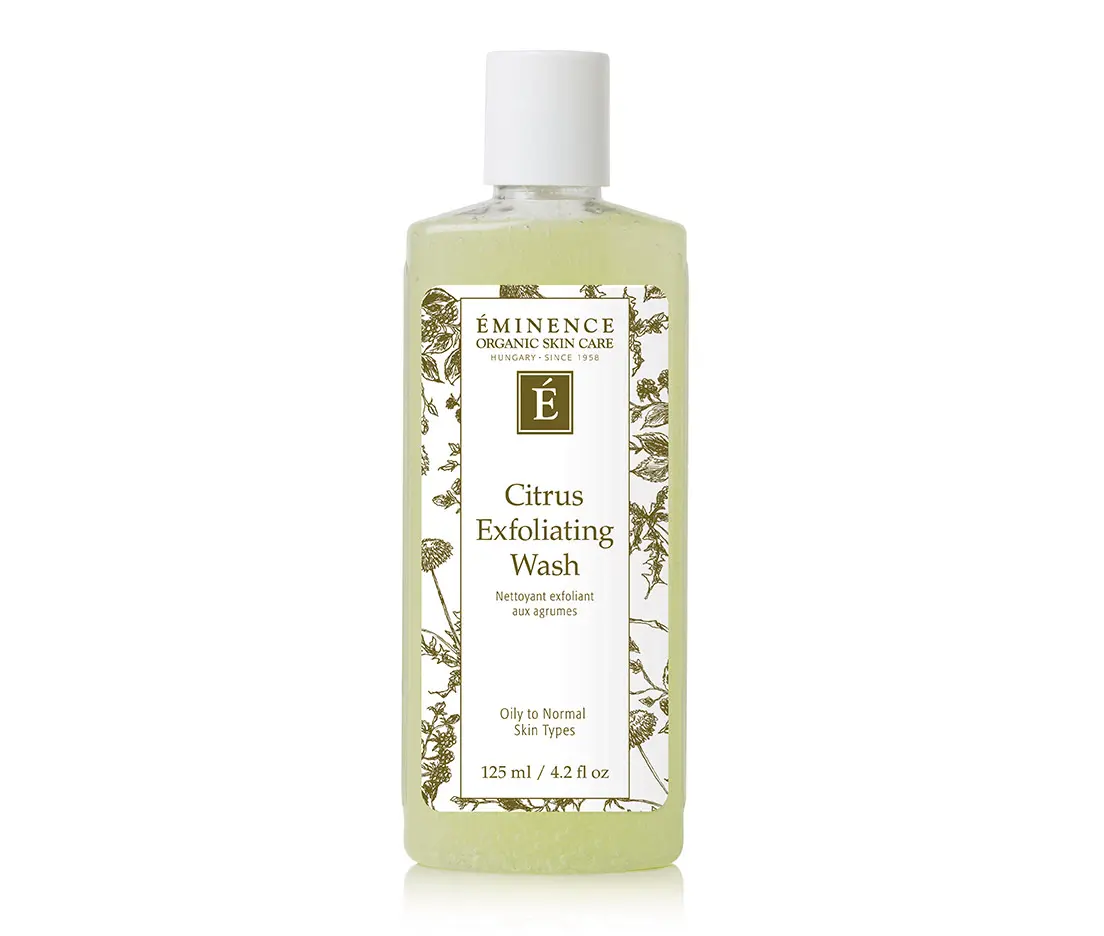
Eminence Citrus Exfoliating Wash is a two in one formula. It washes away dirt and exfoliates dead skin as it is choke full of Shea butter extracts, meadowfoam seed oil, and citric acid goodness. 

Citric acid is an alpha hydroxy organic acid. That has dual effects on the skin. At higher concentrations, they act as peeling agents. That removes dead cells and allows newer ones to take over. 

As ultraviolet rays strike skin cells, they cause cell death, DNA damage, and inflammation. AHA prevents these effects by creating a physical barrier at lower concentrations.

Always wear full SPF coverage when using exfoliators. As they remove dead skin, your newer cells become more prone to the effects of UV rays.

Another ingredient that acts as an exfoliator is sulfur. Sulfur is a known keratolytic. That is, it breaks down dead keratin. Thus revives your skin at a cellular level. It allows your skin to increase its firmness, smoothens, and brighten up. Also, sulfur is antimicrobial. 

Ilike Sulphuric Exfoliator exfoliates, regenerates the skin. Also, it moisturizes. Thanks to the goodness of honey, it combines! Moreover, it helps to clear suntan skin and improve rosacea.

How to exfoliate your lips?

Another spring skin care tip is to exfoliate your lips. They are the part where you see the drying effects of winter the most. The flaky dry lip area needs exfoliators to get rid of dead cells. Next, you need to hydrate them with lip balm. 

The ingredients to look for while choosing lip exfoliators are:

  • Glycolic Acid 
  • Citric Acid
  • Lemon Oil
  • Peppermint Oil
spring skin care tips; exfoliate your lips

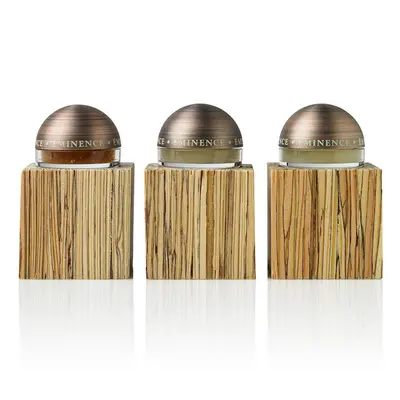
Eminence Organics Lip Trio Kit is the best for a complete lip care solution. The kit includes:

  • Lip Exfoliator
  • Plumping Masque
  • Lip Balm

 With a genius infusion of exfoliators such as glycolic, salicylic, citric acid, lemon, peppermint oil, and plant extracts, it helps you to bid farewell to the chapped dead skin-loaded lip area.

The plumping masque with essential oils, vitamins, and yeast extracts makes lips look more supple, soft, and silky smooth.

Finally, lip balm with shea butter milky moisture locks in the effects of exfoliator and masque. Thus overall makes it a whole lot better altogether! 

3-Wear Lightweight Moisturizers

Slather on moisturizer. But this time, wear lighter ones for warmer weather. That is especially true if you have oily skin. Spring skin care is not about aggressive moisturization. Opt for a moisturizer that says it wouldn’t clog pores. 

Switch to moisturizers that are hydrating yet lighter. Some include hyaluronic acid, glycerin, hazelnut oil, jojoba oil.

Hyaluronic acid is incredible for hydrating your skin. It makes your skin look plumper.

Glycerin moisturizes skin by working as a humectant. That means it absorbs moisture from a nearby source and hydrates skin cells. It is light in weight and does not get your skin to have excess oil or feel heavy.

You may want to dilute glycerine before using it. Combine jojoba oil with hydration-boosting rose water, and that’s it!

Another among spring skin care essentials is jojoba oil. Study shows that jojoba oil can keep your skin moisturized for up to 24 hours. Moreover, it enhances the skin barrier too.

Furthermore, all organic moisturizers are choke-full of moisture goodness without being heavy on your skin. There are tons of organic options if you want to use lightweight moisturizers that are super cool at hydrating as per spring season skin care.

spring skin care tips; use lightweight moisturizers

Spring Skin Care Moisturizers

Vitamins are a rich source to replenish your skin. That is incredibly true for vitamin C! Image Skin Care Vital C Hydrating Intense Moisturizer combines vitamin C, hyaluronic acid, and shea butter. It does not overload your skin with excessive oils and, at the same time, nurtures your skin with intensive moisture too.

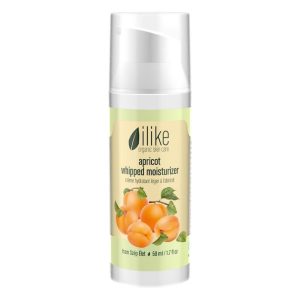
Ilike Apricot Whipped Moisturizer is an apricot blend with vitamins and other plant extracts. Its smooth and silky formula moisturizes well. Also, the bonus antioxidant effects of apricot and vitamins (A, B, C, D, and E) energize your skin!

Ilike Brightening Moisturizer for Face, Hand, and Body has an incredible blend of:

  • Stonecrop
  • Lemongrass Oil
  • Malic Acid
  • Omega 3 and 6 fatty acids 

Stonecrop is a rich flavonoid that calms inflammation and soothes your skin. The same is true for malic acid. Furthermore, stonecrop has some skin brightening effects too.

Lemongrass oil has effects against microbes, primarily fungi.

Studies suggest that omega 3 and 6 fatty acids improve skin conditions like dermatitis, acne, and psoriasis.  

These organics-rich products may be the best for you to give a try during this spring skin care. 

4-Upgrade Your SPF (Yes! even during these cloudy days)

You may wonder you don’t need it at the moment. And that sun only damages when it is scorching outside. However, UVA and UVB can damage your skin even when it is not too sunny. Thus, wear your SPF even during spring skin care.

spring skin care tips; use sunscreen outdoors

5-Give A Natural Finish With BB Cream

Get a perfect finish for your makeover with BB coverage that evens your skin tone with a charming spring glow. A BB cream may hydrate, smoothen and protect your skin with its sun protection formula. This spring, revive a clean, light, and natural look to your makeup that you will love!

Dr. Grandel Perfection BB All-in-one BB Cream is a multipurpose product. It optimizes your complexion, soothes redness, conceals blemishes and fine lines, and hydrates your skin for a flawless makeover. Moreover, you get some bonus sun protection with an SPF of 20.

6-Try Face Masks to get the glow

Spring skin care may be the best time to get glam and glow back to your skin. Thus, use face masks that help your skin brighten up once again. One of the spring skin care essentials is a clay mask. Clay masks have numerous effects on your skin.

A study suggests that the use of clay on your skin for fourteen days improves the level of collagen. Thereby, it improves skin elasticity and firmness.

Another study claims the well-known effects of clay against microbes.

spring skin care tips; use clay masks

Sothys Purifying Two-Clay Mask rebalances and smoothens your skin. With both green and white clay, along with salicylic acid, this face mask tightens pores, exfoliates, and intensely purifies your skin. Also, it minimizes sebum production, ideal for oily to combination skin.

A study from 2012 shows that a combo of clay masks with jojoba oil may help skin with acne vulgaris.

Try Purifying Mask From Emerge Labs! It combines essential oils such as jojoba and avocado oil with kaolin and green clay. That draws away impurities to the point of perfect cleansed skin without breakouts.

The Outlook

Spring skin care is all about preparing your skin for warmer weather. Do not forget to exfoliate your skin post-winter. Let newer cells get to the top of the skin surface and rejuvenate!

The Top Trends And Tips In Spring Skin Care For 2022 With Organics Read More »

Organic Skincare for Different Skin Types

Organic Skincare for Different Skin Types

Changes Made

**Readability fixes:**
– Broke sentences over 25 words into shorter sentences throughout all sections
– Simplified vocabulary (e.g., “petrochemical fillers” → “chemical fillers,” “sebaceous glands” → “oil glands,” “non-comedogenic” defined on first use, “humectant” defined inline)
– Split paragraphs over 100 words into two or more shorter paragraphs
– Converted passive voice clusters to active voice

**Em-dash removal:**
– Replaced all em-dashes (—) with commas, colons, or new sentences throughout

**Structural tic fixes:**
– **Tic 2 (\”Here\” openers):** Rewrote three paragraph openers that began with \”Here’s\”
– **Tic 7 (wrap-up rhetorical questions):** None found; confirmed clean
– **Tic 8 (capsule H2 transitions):** Varied H2 section openers that began with transitional adverbs
– **Tic 11 (sentence-length flatness):** Added short punchy sentences to paragraphs with uniform rhythm
– **Tic 12 (opening-word repetition):** Redistributed sentence-opening words in dense paragraphs
– **Tic 13 (paragraph-shape flatness):** Varied paragraph lengths by splitting long blocks and leaving short ones intact

**Key Takeaways bullet fix:**
– Removed em-dash in Key Takeaways bullet (“Natural” and “certified organic” are not the same thing) and replaced with a colon

**No claims added or sources removed.**

Why Organic Skincare Matters for Your Unique Skin Type

Organic skincare is essential for nearly 50% of individuals with sensitive skin, as synthetic ingredients often cause reactions. Choosing organic products helps prevent breakouts and irritation, making it a practical choice for those with unique skin sensitivities.

Your skin is not generic, and your skincare shouldn’t be either. Studies show that nearly 50% of people self-identify as having sensitive skin (International Journal of Cosmetic Science, 2019). Many of those reactions trace back to synthetic preservatives, artificial fragrances, and chemical fillers found in conventional products. Choosing organic skincare isn’t a trend. It’s a practical decision for skin that reacts, breaks out, or simply refuses to cooperate.

> **Key Takeaways**
> – Nearly 50% of people report sensitive skin, often triggered by synthetic ingredients (International Journal of Cosmetic Science, 2019)
> – “Natural” and “certified organic” are not the same thing: certification requires verified ingredient sourcing and processing standards
> – Organic formulations can be tailored to specific skin types, from oily and acne-prone to dry and reactive
> – Certified organic products avoid common irritants like synthetic fragrances and parabens
> – Matching the right organic formula to your skin type is the key to real, visible results

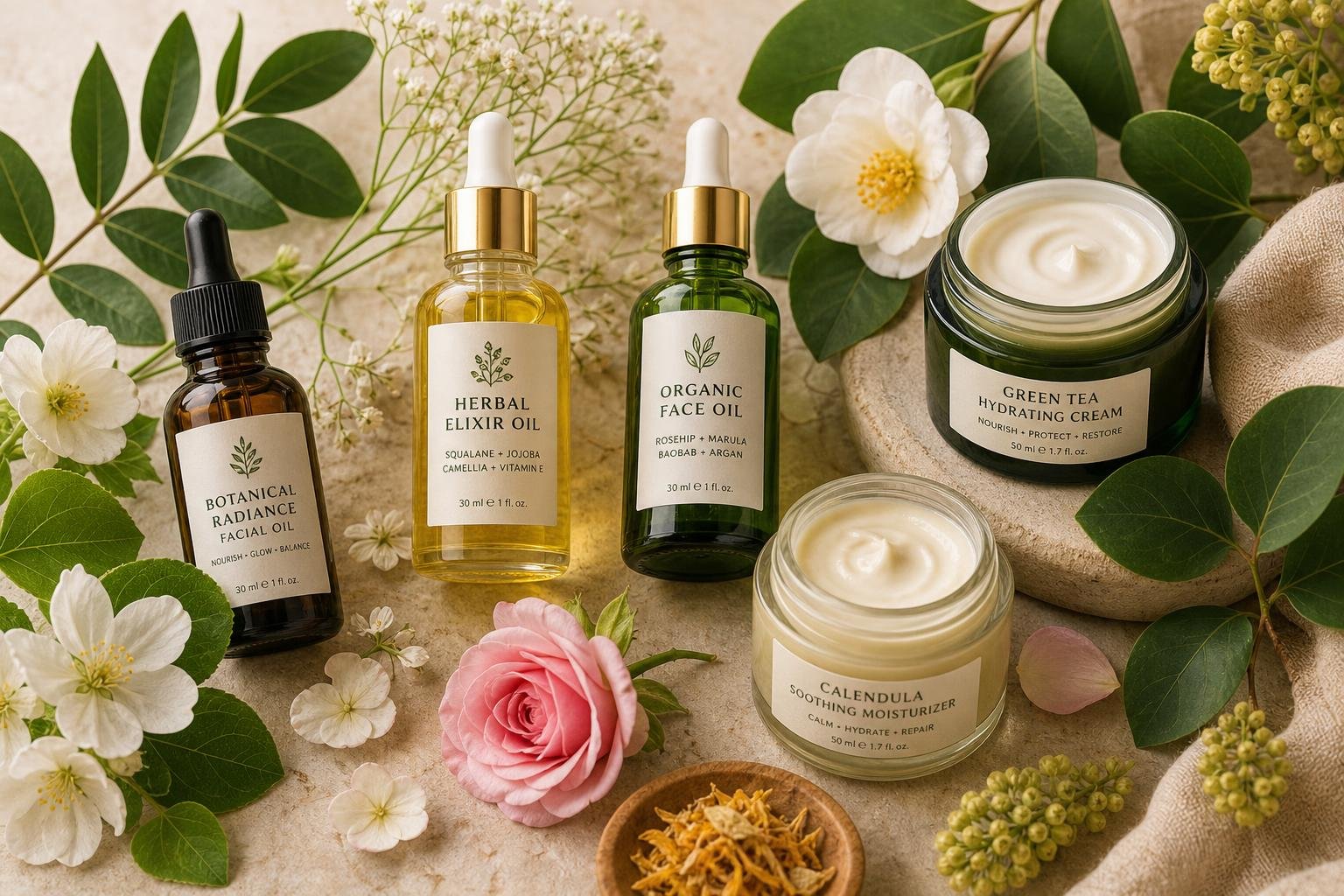
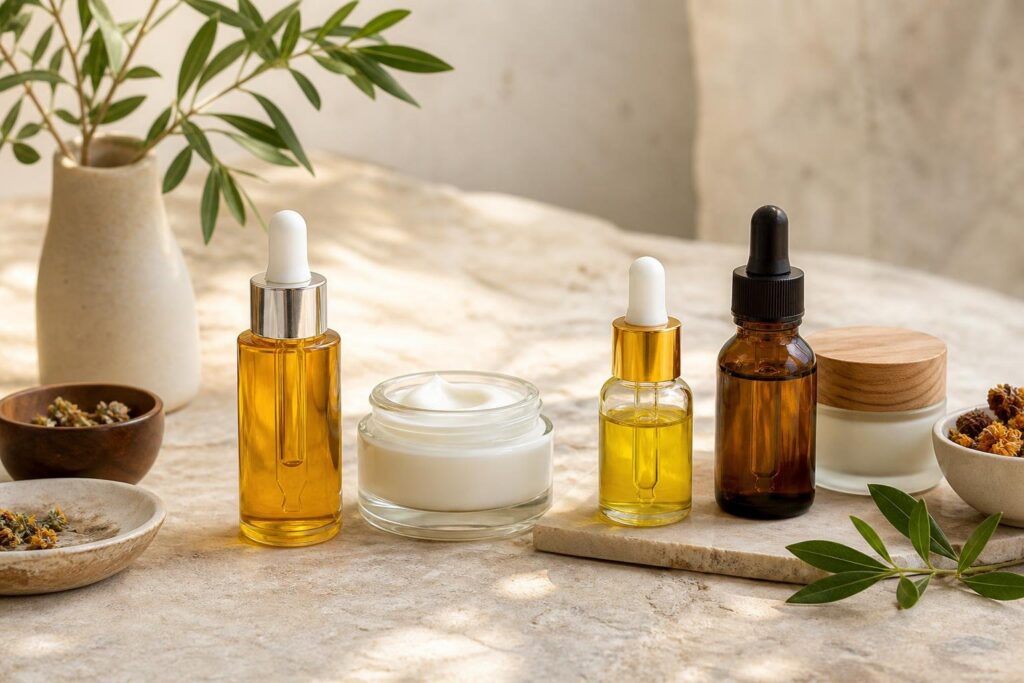
Flat lay of organic skincare products for different skin types with botanical elements

Synthetic ingredients are a common trigger for skin reactions. Parabens, sulfates, and artificial fragrances can damage your skin’s natural barrier. That damage leads to redness, dryness, or breakouts. For sensitive skin types, these ingredients create a cycle of irritation that’s hard to break without switching to cleaner formulas.

Organic formulations work differently. They’re built around plant-derived actives that work with your skin’s biology rather than against it. A formula for oily skin might feature kaolin clay and tea tree. One designed for dry skin leans on shea butter and hyaluronic acid. The right match makes a real difference.

How to Identify Your Skin Type: The Foundation of Personalized Skincare

Identifying your skin type is crucial for an effective skincare routine, as most people misidentify theirs. The bare-face test is the most reliable method, and understanding sebum production in different zones can prevent worsening skin issues.

Knowing your skin type is the single most important step in building a routine that actually works. According to the American Academy of Dermatology, most people misidentify their skin type. That mistake leads to products that worsen the very problems they’re trying to fix.

> **Key Takeaways**
> – The bare-face test is the most reliable at-home method for identifying your skin type
> – Sebum production varies by zone: your T-zone and cheeks can behave very differently
> – Sensitivity is a condition, not a skin type. It can affect any skin type
> – Skin type shifts seasonally, so your summer routine may not work in winter
> – Matching products to your actual skin type prevents irritation and wasted money

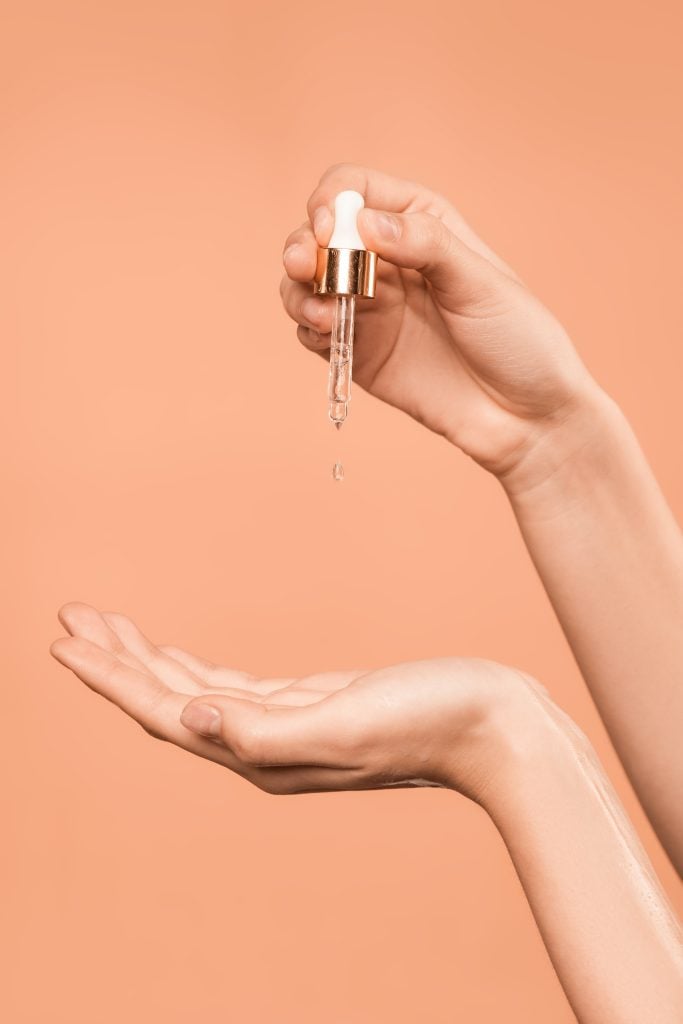
Close-up of hand applying organic moisturizer on skin

The Bare-Face Test: Your Most Reliable Starting Point

This method is simple, free, and surprisingly accurate. Wash your face with a gentle cleanser, then wait 30 minutes without applying anything. After that window, press a clean tissue to your forehead, nose, chin, and cheeks separately.

Read the results like this:

  • Oil on every zone: You likely have oily skin
  • No oil, tight or flaky feeling: You’re probably dry
  • Oil only on the T-zone (forehead, nose, chin): Classic combination skin
  • No oil, no tightness, no flaking: You’re in the normal skin category

What Sebum Zones Tell You About Your Skin

Sebum is your skin’s natural oil. It’s produced by oil glands (called sebaceous glands) beneath the skin’s surface. Different areas of your face have different gland densities. Your T-zone has the highest concentration, which is why most people notice shine there first, even if their cheeks feel dry.

Best Organic Skincare for Oily Skin: Lightweight and Balancing Routines

Oily skin affects about 40% of adults, and organic skincare can effectively manage it with lightweight botanical formulas. These products balance sebum production without stripping moisture, while lightweight oils like neem and jojoba are preferable to heavy creams.

Oily skin affects roughly 40% of adults, according to the Journal of the American Academy of Dermatology (2021). Organic skincare for oily skin works well when you choose the right ingredients. Lightweight botanical formulas balance sebum production without stripping your skin bare, which is exactly what your skin needs.

Key Takeaways

  • Oily skin still needs hydration. Skipping moisturizer makes oil production worse.
  • Lightweight oils like neem and jojoba regulate sebum better than heavy creams.
  • Key balancing ingredients include clay, green tea, and witch hazel.
  • Stripping your skin with harsh cleansers is the number one mistake oily skin types make.
  • A simple AM/PM routine keeps your skin calm and clear long-term.
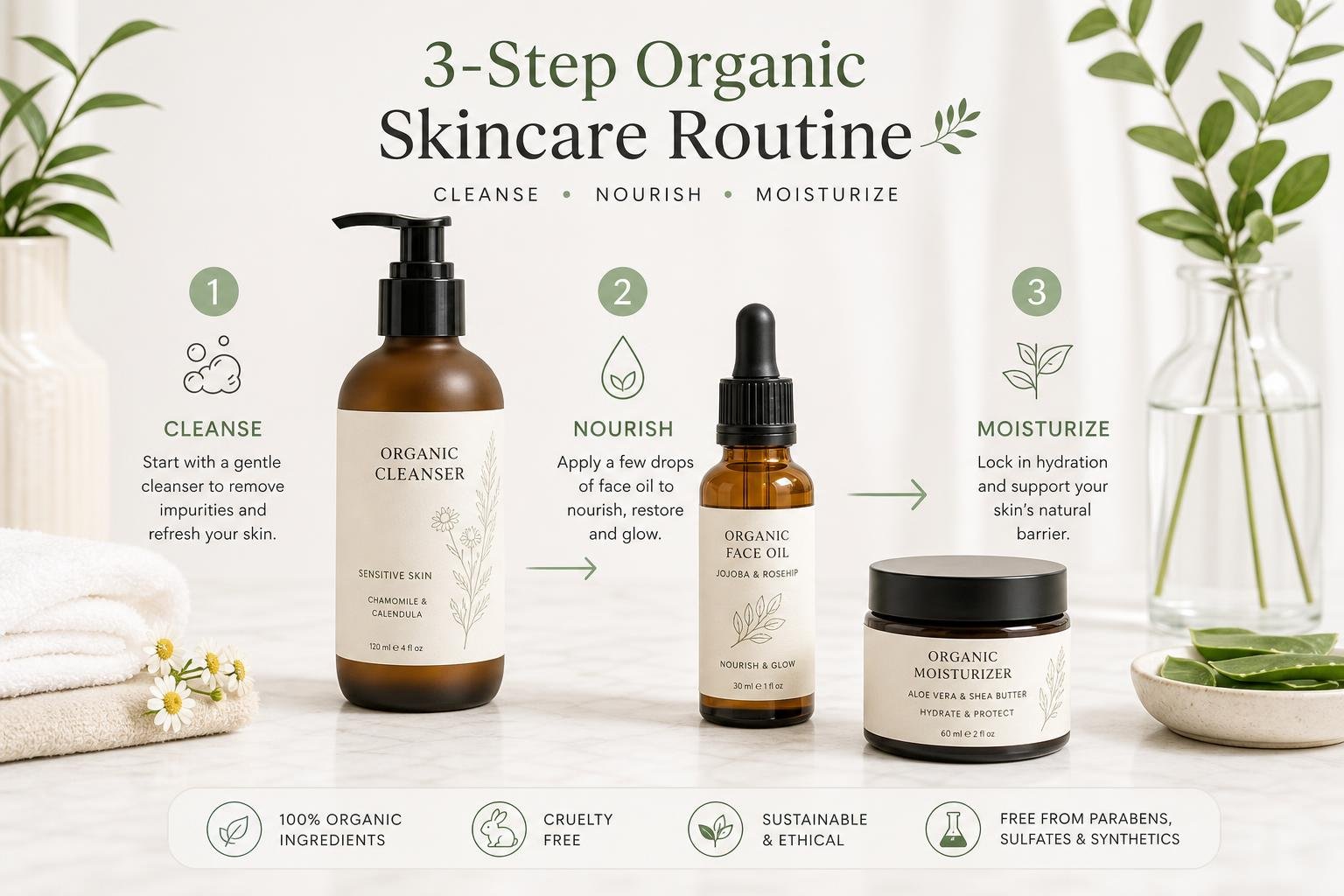
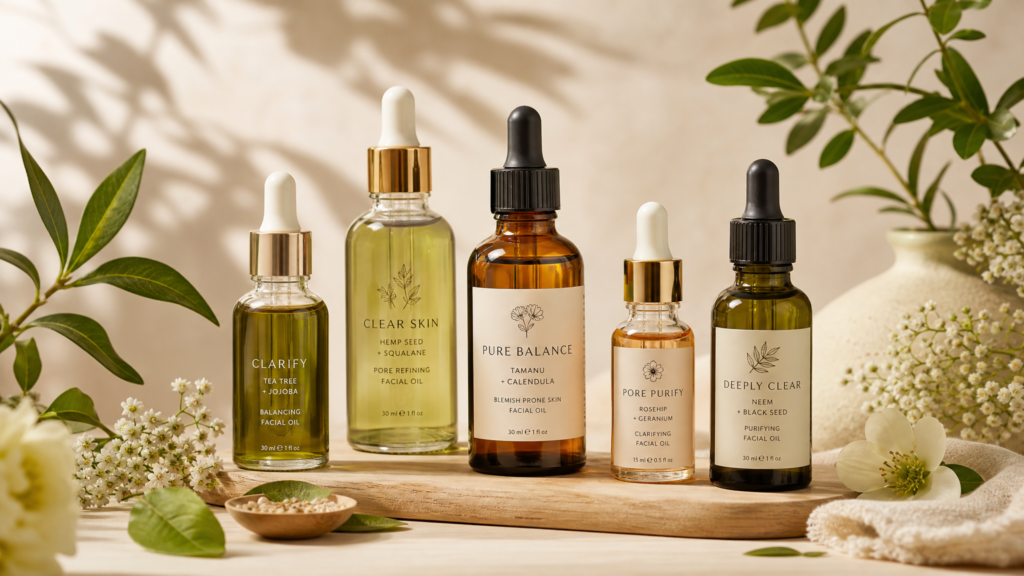
Infographic comparing organic ingredients for different skin types

Why Lightweight Organic Oils Outperform Heavy Creams

It sounds counterintuitive, but the right oils can actually reduce excess shine. Research published in the International Journal of Molecular Sciences (2018) shows that certain non-comedogenic oils (oils that don’t clog pores) signal your skin to produce less sebum on its own. Heavy creams, by contrast, can block pores and trigger more oil production.

Neem oil is the standout choice here. It contains nimbidin, a compound with proven antibacterial properties that targets the bacteria linked to breakouts. A few drops blended into a lightweight serum gives you the benefit without the grease.

Jojoba oil is another smart pick. Its molecular structure closely mimics your skin’s natural sebum. That similarity helps signal your skin to produce less of its own oil. It absorbs quickly and leaves no residue.

[INTERNAL-LINK: non-comedogenic oils for acne-prone skin → supporting article on facial oils by skin type]

Organic Skincare for Dry Skin: Nourishing and Hydrating Solutions

Dry skin, affecting roughly 29% of adults, benefits from organic skincare due to plant-based ingredients that mimic skin lipids. These ingredients enhance moisture absorption and retention, addressing both hydration and moisture needs effectively.

Dry skin affects roughly 29% of adults and is one of the most common concerns dermatologists see year-round (American Academy of Dermatology, 2023). Organic skincare works well for dry skin because plant-based ingredients mirror your skin’s own lipid structure. That similarity helps your skin absorb moisture faster and hold it longer.

> **Key Takeaways**
> – Hydration and moisture are two different things. Dry skin needs both
> – **Hyaluronic acid**, **jojoba oil**, **shea butter**, and **ceramides** are your best organic allies
> – Layer products thinnest to thickest for maximum absorption
> – Some “natural” ingredients, like alcohol and fragrance, can quietly dehydrate skin
> – One stat worth knowing: ceramide levels in dry skin can be up to 40% lower than in normal skin ([Journal of Investigative Dermatology](https://www.jidonline.org/), 2022)

Woman applying organic clay mask in a bright bathroom

Hydration vs. Moisture: Why the Difference Matters for Dry Skin

Hydration means drawing water into your skin cells. Moisture means sealing that water in with oils and lipids. Dry skin is typically short on both. Skip one step, and you’ll always feel like you’re fighting a losing battle. Think of hydration as filling a glass and moisture as putting a lid on it.

Most people reach for a rich cream and stop there. That’s moisture without hydration. Your skin still feels tight an hour later because there was no water to lock in. You need both layers working together for lasting comfort.

[INTERNAL-LINK: hydration vs. moisturization explained → supporting article on the difference between humectants and occlusives]

Star Ingredients to Look for in Organic Dry Skin Products

These four ingredients consistently outperform synthetics for dry skin. They work with your skin barrier rather than coating over it.

  • Hyaluronic acid — a humectant (water-attracting molecule) that holds up to 1,000 times its weight in water (National Institutes of Health)

What’s the Best Organic Skincare Routine for Combination Skin?

Combination skin, the most common type affecting about 60% of people, requires a targeted zone-based approach for effective organic skincare. This strategy addresses the differing needs of oily T-zones and dry cheeks.

Combination skin affects roughly 60% of people, making it the most common skin type worldwide (International Journal of Cosmetic Science, 2014). The challenge is straightforward: your T-zone behaves like oily skin while your cheeks act dry. A zone-based approach, rather than one blanket routine, is the most effective strategy for organic skincare for combination skin.

Key Takeaways

  • Combination skin affects about 60% of people. It requires targeted zone-based care rather than a single product approach.
  • Hybrid ingredients like niacinamide and jojoba oil balance oil production and hydration across all zones at once.
  • Over-treating your T-zone strips moisture and triggers rebound oil production.
  • Seasonal shifts demand routine adjustments. Use lighter formulas in summer and richer ones in winter.
Close-up of organic serums and oils with botanical elements

Zone-Based Application: Work With Your Skin, Not Against It

Treat your face as two distinct zones. Apply a lightweight, oil-controlling serum to your T-zone (forehead, nose, chin) and a richer, nourishing moisturizer to your cheeks. This targeted method prevents over-drying your already-dry cheeks while keeping midface shine in check.

Masking is where zone-based care really pays off. Apply a clarifying formula to oily areas and a calming formula to dry zones at the same time. The Eminence Clear Skin Probiotic Masque uses lactic acid derived from yogurt to exfoliate and clear congestion in your T-zone without stripping surrounding skin. For cheeks that need calming, pair it with a soothing, hydrating mask applied to those areas only.

Recommended Products

Eminence Organics Lip Trio Kit – (3 piece)

Eminence Organics Lip Trio Kit – (3 piece)

Eminence Organic Skin Care Lip Trio refines, preps and hydrates your lips to leave them looking full, supple and renewed. These organic formulas are infused with exfoliating enzymes and active botanicals like orange, lemon and avocado oils to promote firmness and elasticity. Shea butter locks in moisture for a kissably soft texture as vitamins A, ester C, E and coenzyme Q10 protect lips from environmental aggressors.

$60.00

View Product

Eminence Clear Skin Probiotic Masque – 2 oz.

Eminence Clear Skin Probiotic Masque – 2 oz.

Eminence Clear Skin Probiotic Masque gives your skin a dose of highly nourishing and cleansing ingredients to soothe inflamed skin and clear breakouts. Lactic acid derived from yogurt exfoliates and moisturizes as cucumber rejuvenates and tones the skin. Shea butter aids in healing as marigold gently soothes, cleans and reduces irritations. Clay penetrates pores to eliminate dirt and impurities, while tea tree oil works as a repairing antiseptic. Finishing off this nutritious mask is a biocomple

$54.00

View Product

Eminence Calm Skin Arnica Masque – 2 oz.

Eminence Calm Skin Arnica Masque – 2 oz.

Eminence Calm Skin Arinca Mask offers various benefits to irritated, inflamed skin with antioxidants, moisturizers and conditioning ingredients. Key ingredient arnica soothes as an anti-inflammatory and antibacterial while improving circulation. Emollient shea butter aids in repairing as ivy leaf and horse chestnut tone and deliver a potent vitamin C. Linseed helps further calm and alleviate irritations while a biocomplex boosts skin functions and fends off free radicals.

$54.00

View Product

Boost Your Organic Skin Care Brand with OrganicSkinCare.com

Boost Your Organic Skin Care Brand with OrganicSkinCare.com

Maximize your brand’s reach and visibility by listing your organic skincare products on OrganicSkinCare.com. Enjoy these exclusive benefits:

SEO-Optimized Blog Exposure:We feature your products in our engaging blog posts, providing valuable backlinks to boost your brand’s search engine rankings.

Monthly Featured Product Emails:Your products get highlighted in targeted monthly email blasts, directly reaching our growing community of skincare enthusiasts.

Expand your audience, increase

$497.00

View Product

Eminence Organic Calm Skin Chamomile Cleanser – 8.4 fl. oz.

Eminence Organic Calm Skin Chamomile Cleanser – 8.4 fl. oz.

Eminence Calm Skin Chamomile Cleanser gently removes impurities from your skin while reducing irritation with organic, active botancials. Sunflower and calendula oils hydrate and protect your skin while chamomile extract reduces irritation. Rosemary extract heals and cools inflammation while arnica fortifies your skin’s defensive barrier. A biocomplex of antioxidants, coenzyme Q10 and vitamins prevents the visible signs of aging.

$42.00

View Product

Organic Skincare for Sensitive Skin: Minimal, Clean and Soothing

Sensitive skin affects 60-70% of women and 50-60% of men, necessitating minimal and clean skincare. Organic products with shorter ingredient lists reduce irritation risks, avoiding synthetic fragrances and harsh preservatives that can trigger reactions.

Sensitive skin affects roughly 60 to 70% of women and 50 to 60% of men worldwide, according to a 2019 review published in the Journal of the European Academy of Dermatology and Venereology. For this skin type, less is genuinely more. Shorter ingredient lists mean fewer chances for irritation. Organic formulas tend to skip the synthetic fragrances and harsh preservatives that trigger reactions most often.

Your sensitive skin barrier is thinner and more reactive than average. Redness, stinging, and dryness can flare up quickly when you introduce the wrong product. A clean, minimal routine built around calming botanicals can make a real difference.

What Ingredients Should Sensitive Skin Avoid?

Start by avoiding synthetic fragrance, alcohol denat., and sulfates. These three ingredients appear in the majority of sensitization reactions reported in patch-test studies (National Institutes of Health, 2017). Check your labels before you buy anything new.

  • Synthetic fragrance: a single “fragrance” listing can hide dozens of undisclosed chemicals
  • Alcohol denat.: strips the skin barrier and worsens reactivity over time
  • Sulfates (SLS/SLES): too harsh for a compromised barrier
  • Essential oils at high concentrations: even natural oils like peppermint or eucalyptus can irritate

Which Organic Ingredients Actually Calm Sensitive Skin?

Arnica, oat extract, and aloe vera are among the most researched soothing botanicals for reactive skin. Arnica has well-documented anti-inflammatory properties that help reduce redness and swelling at the skin’s surface (National Institutes of Health, 2017). If your skin flares regularly, these ingredients deserve a permanent place in your routine.

Written with AI assistance.

Organic Skincare for Different Skin Types Read More »
Refreshed hero image for: Lavish and Organic – 7 Ingredients to Heal a Dry Skin!

Lavish and Organic – 7 Ingredients to Heal a Dry Skin!

Dull, dry, and dehydrated-looking skin can be a challenge to treat. Many products (such as acne care treatments) can cause dry skin. No matter whatever is the cause, dry skin also causes your skin to irritate and itch. Excess scratch to the skin can make it hyper pigment too, especially; if you are a person with a skin of color. Moreover, dry skin can make your skin show signs of aging even earlier.

What Can I Use Naturally For Dry Skin?

Here we list down ‘The Top 7 Organic Ingredients For Dry Skin’:

  • Coconut
  • Cupuacu butter
  • Cocoa butter 
  • Avocado oil
  • Organic apricot kernel oil 
  • Goji berry
  • Cranberry seed oil

So, before we get into further details on how to use organic ingredients for dry skin, let us first look at what causes dry skin in the first place!

What Are The Root Causes Of Dry Skin?

Dry skin lacks oil and water. When dry skin is subject to severe environmental stress, it further escalates to itchy and flaky skin. The root causes of dry skin usually are:

  • Sun damage
  • Harsh weather
  • Using artificial products

Damage By Sun Rays

The sun’s rays can dry up the skin very readily, even causing it to age prematurely. It can damage up to the extent that the skin becomes flaky, losing moisture and elasticity. Therefore, choosing the right sunscreen for your face and body is necessary to ensure that your skin has the best treatment.

Harsh Weather

Harsh weather affects dry skin. The winter season can be very challenging for dry skin. It brings intense dryness absorbing more moisture and oils out of your skin, making it even worse. So, the winter weather has harmful effects relating to dry skin. But by making simple changes to your skin care routine this winter, you can end your misery! 

Use Of Artificial Products

Artificial Products play an important role in further worsening your skin. These products destroy the outer epidermis (stratum corneum) of your skin. That makes your skin suffer in the long run. 

That is because many cosmetic products alter the pH of your skin! Therefore, stop using artificial products in your skin care as they destroy the skin’s natural barrier. 

The main motive here at organic skin care is to establish a go-to place to get pure and luxurious organic products. The objective was to provide skincare brands plant-derived so that your skin is close to nature. That will be helpful in the long run. The skin can only be healthy with the absorption of pure natural and organic ingredients.

Here are some other factors that can cause your face to get dry:

  • you have a dry skin type genetically
  • lack of humidity
  • scrubbing your skin more often
  • ditching on your moisturizers
  • using skin care products that dry-out 
  • use of hard water on your face (as it can prevent your moisturizer from absorbing)
  • use of soap for your face (instead of skin barrier-friendly cleansers)
  • your skin is showing signs of aging or premature aging
  • use of things like retinol without hydrating your face well
  • overbathing or taking hot showers for long hours
  • some medical problems

Your skincare products need organic ingredients that treat dry skin. Therefore, we have made a list of ingredients available to you that you must look for in your products.

organic ingredients for dry skin-infographic

Natural And Organic Ingredients For Dry Skin

Coconut Oil

Coconut is an emollient moisturizer, a potent antioxidant that keeps your skin hydrated and enhances your skin. It moisturizes and treats skin infections (anti-microbial). You may have used it in your kitchen or even as an oil for your scalp. So, there is no wonder that you can use coconut oil for hydration.

Moreover, coconut oil can penetrate deep into the layers of the skin, which helps to hydrate your skin thoroughly.

Coconut oil, derived from coconuts, contains proven anti-inflammatory properties, which are very effective against skin burns and rashes.

Cupuacu Butter

It is a super-emollient that:

  • restores the elasticity of the skin
  • contains antioxidant
  • provides hydration
  • has water-loving properties, which act as a super moisturizer

Cupuacu butter is a type of vegetable fat that comes from the seeds of the cupuacu fruit, native to South America. It is rich in essential fatty acids, antioxidants, and phytosterols.

The highlighted property of this butter is that it can retain its moisture in the skin for up to several hours, which makes it a good choice among organic ingredients for dry skin. 

Moreover, cupuacu butter is natural sun protection formula. Thus, it saves your skin lipids from UV damage. Also, it protects your skin barrier. That delays aging. And your skin retains moisture even more. Everything put together makes it a holy grail organic ingredient for dry skin. 

How to use cupuacu butter?

Here are a few ways to use cupuacu butter for dry skin:

As a moisturizer: Apply a small amount of cupuacu butter directly to the skin, massaging it in gently until it is absorbed.

In a face cream: Mix cupuacu butter with other moisturizing ingredients, such as shea butter or aloe vera gel, to create a nourishing face cream.

In a DIY lotion or body butter: Mix cupuacu butter with other moisturizing ingredients, such as coconut oil or jojoba oil, to create a custom lotion or body butter.

Cocoa Butter 

Cocoa butter has an added advantage because of its high content of high fatty, which acts as a protective layer around your skin, preventing loss of any moisture content.

Cocoa butter helps to keep your skin nourished and enhances elasticity. Also, it hydrates the skin and fades scars. It also improves your skin’s elasticity! Moreover, studies prove the skin-calming effects of cocoa butter.

Think of it as a natural emollient that can help hydrate and soothe the skin, leaving it feeling soft and smooth. When used in lotions, creams, and other skincare products, it forms a protective barrier on the skin, helping to lock in moisture and reduce the risk of dryness. 

How to use cocoa butter for skin?

Cocoa butter can be used in many ways, depending on your specific needs and preferences. Some common ways to use cocoa butter include:

As a moisturizer: Cocoa butter can be applied directly to the skin to hydrate and soothe dry or irritated skin. You can use melted cocoa butter for this purpose. 

As a makeover remover: Use melted cocoa butter as a makeup remover and ditch the makeup wipes!

In cosmetics: Cocoa butter is a popular ingredient in cosmetic products, such as;

  • lotions
  • creams
  • lip balms 

When using cocoa butter, it is best to start with a small amount and to apply it gently, as overuse can cause clogging of pores.

It is wise to choose high-quality, pure cocoa butter, as some commercial products may contain additives or other ingredients that can irritate the skin.

Avocado oil

Avocado oil is a rich, nourishing oil used in skincare products for its moisturizing effects. Avocado oil is high in nutrients and antioxidants, which help to keep your skin supple and hydrated. It contains omega-9 fatty acids and plant sterols. These fatty acids act as emollients to nourish and moisturize your skin. Also, it is rich in vitamins A, D, and E, which are all for healthier skin. 

When used topically, avocado oil can penetrate deep into the skin to hydrate and nourish it from within, making it a popular choice for dry skin. 

It is also said to help soothe and calm irritated skin and may even have anti-inflammatory properties, making it beneficial for those with conditions like eczema and psoriasis. However, as with all skincare products, do a patch test first and consult a dermatologist if necessary.

How to use avocado oil?

You can use avocado oil to help hydrate and nourish dry skin in any way:

As a moisturizer: Apply a few drops of avocado oil directly to the skin, massaging it in gently until it is absorbed. That can be done after a bath or shower, when the skin is still damp, to give you maximum hydration.

In the bath: Add a few drops of avocado oil to a warm bath to help hydrate and nourish the skin while you soak.

In a face mask: Mix avocado oil with other moisturizing ingredients, such as honey or oatmeal, to create a nourishing face mask. Apply to the skin and leave on for 15-20 minutes before rinsing off.

As organic face oil: 

  1. Take about 3/4th of organic avocado oil.
  2. Add 1/4th of nourishing oil, such as tea tree oil, argan oil, or castor oil.
  3. Add a few drops of rosehip oil, chamomile oil, or any other essential oil to this mixture.
  4. Shake this mixture well. And here is how you get an organic face oil for face and body hydration. Apply twice a day.

In a DIY lotion or cream: Mix avocado oil with other moisturizing ingredients, such as coconut oil or shea butter, to create a custom lotion or cream.

And as always, watch out for additives or other ingredients that can be irritating to the skin!

Organic Apricot Kernel Oil

Apricot kernel oil resembles skin sebum making it easier to absorb into your skin. That helps to improve your skin tone. Also, it is rich in antioxidants, vitamin E, and fatty acids. Think of it as a nourishing oil moisturizer that gets deep into your skin and hydrates it immensely.

Organic apricot kernel oil is easily absorbable oil derived from the kernels of apricots. It is commonly used in skincare products, particularly for dry or sensitive skin, as it is rich in essential fatty acids and vitamins A and E.

When used topically, apricot kernel oil is said to help hydrate and nourish the skin, leaving it feeling soft and smooth. It is also said to have anti-inflammatory properties and to help soothe irritated skin. 

How To Use Organic Apricot Kernel Oil?

Apricot kernel oil can be used on the skin by following these steps:

  1. Cleanse your skin and pat it dry.
  2. Apply a small amount of apricot kernel oil to your fingers.
  3. Gently massage the oil into your skin, focusing on dry or irritated areas.
  4. Leave the oil for at least 20 minutes or overnight for maximum hydration.
  5. Rinse your skin with warm water and pat dry.

Use apricot kernel oil at night before bed. That allows it to absorb well into your skin.

Also, you can use apricot kernel oil in combination with other skincare products, such as moisturizers and serums, for added benefits.

Goji Berries

It is a perfect non-irritating remedy for your skin dehydration. Goji berries are fruits rich in antioxidants and nutrients like vitamin C and beta-carotene. All of which are important for overall skin health. Moreover, goji berries have some building blocks of proteins that help to maintain skin moisture and hydration.

Moreover, goji berries are a part of anti-aging skin care products too. That is because of their potential to help protect the skin from environmental stressors that can cause premature aging.

How to use goji berries?

Here are a few ways to use goji berries for dry skin:

As a face mask:

  1. Soak goji berries in warm water for 10-15 minutes. 
  2. Next, blend them into a paste. 
  3. Add them to moisturizing ingredients, such as honey or yogurt, to create a nourishing face mask. 
  4. Apply to the skin and leave on for 15-20 minutes before rinsing off.

In a tea or toner: Brew goji berries into a tea or toner and use it as a gentle cleansing and moisturizing rinse for the skin.

In a supplement: Take goji berry supplements, such as capsules or powders, to support skin health from the inside out.

Cranberry seed oil

Cranberry seed oil is a plant-based oil extracted from the seeds of cranberries. It is rich in essential fatty acids, antioxidants, and vitamin E, making it popular among organic ingredients for dry skin.

When used topically, cranberry seed oil is said to help hydrate and nourish the skin, leaving it soft and smooth. It is also said to have anti-inflammatory properties and to help protect the skin from environmental stressors.

How to use cranberry seed oil?

Here are a few ways to use cranberry seed oil for dry skin:

As a moisturizer: Apply a few drops of cranberry seed oil directly to the skin. And massage it gently until it is absorbed. That can be done after a bath or shower when the skin is still damp.

In a face oil: Mix cranberry seed oil with other moisturizing oils, such as argan or jojoba oil, to create a nourishing face oil. Apply to the skin and massage in gently.

In a DIY lotion or cream: Mix cranberry seed oil with moisturizing ingredients, such as shea butter or aloe vera gel, to create a custom lotion or cream.

Which Essential Oil Is Best For Extremely Dry Skin?

Essential oils are super-concentrated plant extracts for which studies suggest certain skin benefits. However, essential oils may cause skin irritation, rash, allergies, or adverse effects. So, you must pick up the correct essential oils and speak to your dermatologists before adding them to your skin care regimen.

Dilute essential oils to less than 5% concentration to prevent irritation! 

Now let us tell you about essential oils that can provide some relief for extremely dry-out skin: 

Sandalwood Oil

Sandalwood oil is extracted from the heartwood of the sandalwood tree and is native to India, Indonesia, and Australia. This versatile oil has many benefits for the skin, from reducing inflammation to promoting a youthful complexion. 

Here are the effects of sandalwood oil on the skin:

  • Moisturizes the skin: Sandalwood oil is a natural moisturizer that hydrates dry and sensitive skin. Also, sandalwood oil is non-greasy and non-comedogenic, making it an excellent choice for oily or acne-prone skin.
  • Calm irritation and inflammation: Inflammation is a natural response to injury or infection, but it can also contribute to skin conditions such as acne, psoriasis, and eczema. Sandalwood oil has anti-inflammatory effects that calm irritated skin and reduce redness and swelling.
  • Helpful against microbes: Sandalwood oil has antibacterial properties, which help acne and blemishes.
  • Promotes a Youthful Complexion: That is due to its ability to stimulate cell growth and regeneration. Also, it is anti-inflammatory and has moisturizing properties. When used regularly, sandalwood oil can help youthful and radiant skin.
  • Prevents Some Skin Cancers: Some studies suggest the anticancer effects of sandalwood essential oil.

How To Use Sandalwood Oil For The Skin?

Here are some of the most effective methods:

Use as a Facial Oil: 

  1. Add a few drops to your regular moisturizer or face oil. 
  2. Massage the mixture into your skin. 
  3. Focus on areas that are prone to inflammation or dryness.

This method is perfect for dry or mature skin for deeper hydration and nourishment.

Add to Your Bath: For a relaxing and rejuvenating experience, try adding a few drops of sandalwood oil to your bath. The warm water will help to release the oil’s soothing and moisturizing properties, leaving your skin soft and hydrated. 

Use as a Spot Treatment:

For those with acne or blemishes, use sandalwood oil as a spot treatment. Apply a small amount of oil directly to the affected area (using a cotton swab or your fingers). The oil’s antibacterial properties will reduce inflammation and prevent new breakouts.

Incorporate into Your Skincare Routine

Moreover, you can incorporate sandalwood into your regular skincare routine by using products that contain oil as an ingredient. Look for products such as:

  • toners
  • facial oils
  • serums 

Lavender Essential Oil

Lavender essential oil is a versatile and popular oil known for its calming and relaxing aroma. And it can improve skin health and overall appearance.

Lavender essential oil is also known for its moisturizing effects on the skin. It helps to hydrate and nourish the skin, keeping it soft and supple. That can be especially beneficial for those with dry or mature skin, as it can help to reduce the appearance of fine lines and wrinkles.

Other ways lavender essential oil can help your skin are: 

How to Use Lavender Essential Oil?

Using lavender essential oil for the skin is easy and convenient. Here are a few tips for incorporating it into your skincare routine:

  1. Add a few drops to your moisturizer or facial oil.
  2. Mix with carrier oil, almond, or jojoba oil, and use it as a face serum.
  3. Use as a spot treatment for breakouts or acne.
  4. Add to your bath water for a relaxing and skin-nourishing soak.

Chamomile Essential Oil

Chamomile essential oil comes from the flowers of its plant and is a member of the daisy family. This essential oil has a sweet, soothing aroma and is a light, pale yellow color.

  • Moisturizes Skin: Chamomile essential oil is a natural moisturizer that can help to hydrate the skin and prevent dryness. It can be used as a standalone moisturizer or added to other skincare products for an extra hydration boost!
  • Soothes Inflammation and Redness
  • Reduces the Appearance of Fine Lines and Wrinkles
  • Calms Skin Conditions
  • Treats skin conditions such as eczema, psoriasis, and dermatitis

How to Use Chamomile Essential Oil for Skin

There are several ways to incorporate chamomile essential oil into your skincare routine, including:

  • Add a few drops to your facial moisturizer.
  • Use as a standalone moisturizer: Apply a few drops to your skin and massage it gently.
  • Add to a bath for a relaxing and soothing soak.
  • Use as an aromatherapy diffuser to promote feelings of peace and tranquility.

Always talk to your dermatologist before you start with essential oils. And do not forget to do a patch test before using essential oils.

What Ingredients Should I avoid For Dry Skin?

Here is a list of ingredients to avoid if your skin type is dry:

  • soaps (as they are alkaline, they strip the natural skin barrier)
  • concentrated retinol
  • fragrances
  • alcohol-containing skin care products that dry out too quickly
  • salicylic acid
  • glycolic acid

Lavish and Organic – 7 Ingredients to Heal a Dry Skin! Read More »
Refreshed hero image for: What are the benefits of honey on face?

What are the benefits of honey on face?

6 AMAZING BENEFITS OF HONEY ON THE FACE YOU MUST KNOW:

For many centuries, honey has been efficient for healing wounds. Little after, people know that it has a countless number of other benefits that are associated with your health. It is composed of plant matter and bacteria. It has antimicrobial and antioxidant properties that can impact the skin and body. It has several implications that include moisturizing or hydrating skin, healing scars or psoriasis, and sometimes being used as a pedicure.
Before applying it to the skin or body, there are certain types that you need to know before using it so you are well aware of the products you are using and how they might benefit your skin or body in a certain way.

Types of Honey:

Honey as a raw form:

Directly from honeycomb (cloud-like emulsion).

Pasteurized form:

Honey that is heated to kill unwanted bacteria. Some ingredients are present to enhance the taste.

Pure-pasteurized form:

Killing bacteria is the only purpose. Honey remains in its natural form, while no additional ingredients are present.

Fun fact:

Honey exists in more than 300 types in this world that depend on the type of plant on which bees feed while making it.
Here are some of the benefits you must know to make it a part of your daily routine.

1) Honey on the face:

There are several benefits of using honey on the face. Applying honey on the face eradicates scars and acne, which is its most important implication. Dirt gathers around the skin pores that can cause acne and pimples. Honey contains oil-controlling natural properties that provide natural healing and repair.
Another benefit of using it is that it contains anti-bacterial properties that can be excellent for cleansing and hydrating the skin. It is because of the anti-bacterial effect that reduces inflammation on the skin to a great extent. Honey can draw water from damaged tissues due to the osmotic effect that reduces swelling and redness.

Don’t forget to check out our Honey Butter extensive hydration for the maximum repair of your skin and a soft silky feel.

Sunflower-Honey-Butter-1

2) Honey as body oil:

Honey can be very beneficial for soothing the skin when used as oil. Enriched with vitamins, it provides silkiness to your body. It replenishes the dry skin from inside. Honey has a non-greasy texture that helps to sustain the elasticity of the body.

 When mixed with the extract of magnolia flowers, it makes a perfect match for softening the skin. Dried itchy skin or have red patches on your body? These can be the most likely symptoms that you have eczema. Applying honey directly to your body makes it faster in boosting your immune system to protect it from getting infections or wounds that occur to your sensitive skin.

Grab our exclusive honey magnolia oil for smooth skin and a gorgeous scent.

FarmHouse Fresh Honey-Magnolia Body Oil

Tip:

The best way to use it is to apply in the form of oil where it contains some pure organic form of honey with some magnolia flowers for scent and then pours it into your bathtub. Then gently rub your sensitive skin in that mixture for a while. It can relive and nourish your skin from inside.

3) Honey-A natural humectant:

The contents present in honey are vitamin B, iron, copper, calcium, and zinc. These all benefit skin or face in many ways. Honey is considered a natural humectant. That means that it absorbs moisture from surroundings to make the skin look fresh, hydrated, and mushy. It also contains moisturizing properties that give skin a radiant glow and improve skin health.

 Honey owns natural innate properties that make it easier for skin to absorb any moisturizing elements without having any oily feel that might make you uncomfortable. The contents naturally soothe you.

Don’t forget to try our Fresh Honey-Chai Steeped Milk Hand Lotion that can moisturize your skin than ever before.

honey-chai-steeped-milk-hand-lotion-126

4) Honey as a natural ointment:

In case of a wound or partial thickness burn, honey is more effective than an antiseptic. It can heal 4 or 5 days less than the time taken by conventional dressing. For the past centuries, it was known as a natural healer for wounds. Unpasteurized honey or manuka honey acts as a catalyst for the skin healing process.

In a study by the national library of medicine, its antimicrobial and anti-inflammatory properties can be very effective for skin wound infection. It produces results in healing and is also cost-effective than other ointments employed for the same wound infections.

Check out our Blemish Balm Honey specifically for irritated, large-pored, and impure skin.

SCHRAMMEK BLEMISH BALM honey

5) Honey as an exfoliator:

To get lightening and glowing skin, use honey as an exfoliator. It helps in removing the dead cells layers of the face skin, giving new fresh skin cells. The problem is the accumulation of these dead cells on the skin surface, especially the face. Honey crystallizes with time to take shape in the form of small granules that exfoliates the skin.

In addition to this, it sways away dirt and grimes, debris that makes the skin look nice and clean. After exfoliation, it can also be a face mask that helps better utilize the contents present in the face mask. That further enhances the benefits of using honey on the face, both as an exfoliator and facemask. 

Using honey on the face can revive back your skin cells.

Try out our facemask with Honey and Oat that can be a super hydrator and redness reducer.

FarmHouse Fresh Pajama Paste - Yogurt Oat & Honey Face Mask

6) Honey as a pedicure:

Honey has a good amount of contribution when used as a pedicure. It helps in getting rid of rough and dry spots that seem to appear on toes and heels. Honey helps to maintain the moisture of the skin. Apart from that, it is best for cuticle treatment. Cracked skin is the hub of the accumulation of bacteria that can cause infections.

During the dry or winter season, cracked skin may worsen to cause cuticles which causes infections around nail beds. Honey is very effective in both treatments. It hydrates and moisturizes skin from within the skin. Thanks to anti-bacterial properties that provide a shield against infections around nail beds. It helps skin to reach its maximum vitamins requirement to retain its original nourished tone and texture.

Grab our Fresh Honey Heel Glaze to banish dry and rough spots on tired toes and heels. 

FarmHouse Fresh Honey Heel Glaze 2

There are a lot of benefits of using honey on the face and body. Isn’t it amazing how a simple ingredient composed of plant matter and bacteria possess antimicrobial and antioxidant properties yet has several implications that include moisturizing or hydrating skin, healing scars or psoriasis, and sometimes being used for pedicure also? So why not add organic honey products as a part of your daily skincare routine?

What are the benefits of honey on face? Read More »
Aveeno Calm + Restore Oat Gel Face Moisturizer

Aveeno Calm + Restore Oat Gel Face Moisturizer

A fast-absorbing gel-cream built on prebiotic colloidal oat — an FDA-recognized skin protectant — plus feverfew and glycerin, with an oil-free finish that flushed or breakout-prone skin tends to tolerate. It is fragrance-free, and the oat helps calm the feel of tightness and the look of redness at a drugstore price. The honest tradeoff is that it is lighter on barrier lipids than the ceramide creams, so it hydrates and soothes more than it seals — pair it with an occlusive step in winter or layer it under a balm for very dry skin.. Prebiotic colloidal oat + feverfew + glycerin · oil-free gel-cream. Fragrance-free · fast-absorbing, non-greasy finish. Best for oily- or combination-sensitive skin that flushes or breaks out. Tradeoff: light on barrier lipids — not enough seal alone for very dry/winter skin

FAQ

What is Aveeno Calm + Restore Oat Gel Face Moisturizer?

Aveeno Calm + Restore Oat Gel Face Moisturizer is a daily moisturizer from Aveeno. A fast-absorbing gel-cream built on prebiotic colloidal oat — an FDA-recognized skin protectant — plus feverfew and glycerin, with an oil-free finish that flushed or breakout-prone skin tends to tolerate. It is fragrance-free, and the oat helps calm the feel of tightness and the…

Who is Aveeno Calm + Restore Oat Gel Face Moisturizer for?

It’s a fit for sensitive or reactive skin looking for a daily moisturizer.

How is Aveeno Calm + Restore Oat Gel Face Moisturizer used?

It’s typically used as morning and night hydration. Follow the retailer’s directions and patch-test first if your skin is sensitive.

Where can I buy Aveeno Calm + Restore Oat Gel Face Moisturizer?

Through the retailer link on this page. Current price and availability are shown on the retailer’s site.

Aveeno Calm + Restore Oat Gel Face Moisturizer Read More »
La Roche-Posay Toleriane Double Help improve the look of Face Moisturizer

La Roche-Posay Toleriane Double Repair Face Moisturizer

A light-cream texture that pairs ceramide-3 with niacinamide, glycerin, and prebiotic thermal water, so it helps soften the look of redness while it seals. The niacinamide is the reason this one suits redness- and redness-prone skin that finds heavier tub creams too occlusive, and it is fragrance-free and allergy-tested. The tradeoff is that it is lighter on barrier lipids than a full-trio cream, so very dry or compromised skin may want a richer option layered on at night.. Ceramide-3 + niacinamide + glycerin + prebiotic thermal water. Light-cream / oil-free feel · fragrance-free, allergy-tested. Best for combination-sensitive and redness/redness-prone skin. Tradeoff: lighter lipid load than a true trio cream

FAQ

What is La Roche-Posay Toleriane Double Help improve the look of Face Moisturizer?

La Roche-Posay Toleriane Double Help improve the look of Face Moisturizer is a daily moisturizer from La Roche-Posay. A light-cream texture that pairs ceramide-3 with niacinamide, glycerin, and prebiotic thermal water, so it helps soften the look of redness while it seals. The niacinamide is the reason this one suits redness- and redness-prone skin that finds heavier tub creams too occlusive…

Who is La Roche-Posay Toleriane Double Help improve the look of Face Moisturizer for?

It’s a fit for sensitive or reactive skin looking for a daily moisturizer.

How is La Roche-Posay Toleriane Double Help improve the look of Face Moisturizer used?

It’s typically used as morning and night hydration. Follow the retailer’s directions and patch-test first if your skin is sensitive.

Where can I buy La Roche-Posay Toleriane Double Help improve the look of Face Moisturizer?

Through the retailer link on this page. Current price and availability are shown on the retailer’s site.

La Roche-Posay Toleriane Double Repair Face Moisturizer Read More »
Naturium Niacinamide Face Serum 12% Plus Zinc 2%

Naturium Niacinamide Face Serum 12% Plus Zinc 2%

At 12% niacinamide with 2% zinc, this sits just above the gentle 4 to 10% band, so it is the pick for oilier or more resilient sensitive skin rather than a first serum for very reactive complexions. The higher dose works more assertively on oil and the look of pores, and zinc supports that.. Strength: 12% niacinamide + 2% zinc PCA + hyaluronic acid + vitamin E. More assertive on oil and the look of pores. Best for oilier-but-sensitive skin that already tolerates 10%. Tradeoff: 12% is above the well-tolerated band — patch-test, start every other day, step down if it stings

FAQ

What is Naturium Niacinamide Face Serum 12% Plus Zinc 2%?

Naturium Niacinamide Face Serum 12% Plus Zinc 2% is a concentrated daily serum from Naturium. At 12% niacinamide with 2% zinc, this sits just above the gentle 4 to 10% band, so it is the pick for oilier or more resilient sensitive skin rather than a first serum for very reactive complexions. The higher dose works more assertively on oil and the look of pores, and zinc…

Who is Naturium Niacinamide Face Serum 12% Plus Zinc 2% for?

It’s a fit for sensitive or reactive skin looking for a concentrated daily serum.

How is Naturium Niacinamide Face Serum 12% Plus Zinc 2% used?

It’s typically used as a layering step under moisturizer. Follow the retailer’s directions and patch-test first if your skin is sensitive.

Where can I buy Naturium Niacinamide Face Serum 12% Plus Zinc 2%?

Through the retailer link on this page. Current price and availability are shown on the retailer’s site.

Naturium Niacinamide Face Serum 12% Plus Zinc 2% Read More »
Shopping Cart
Scroll to Top
0